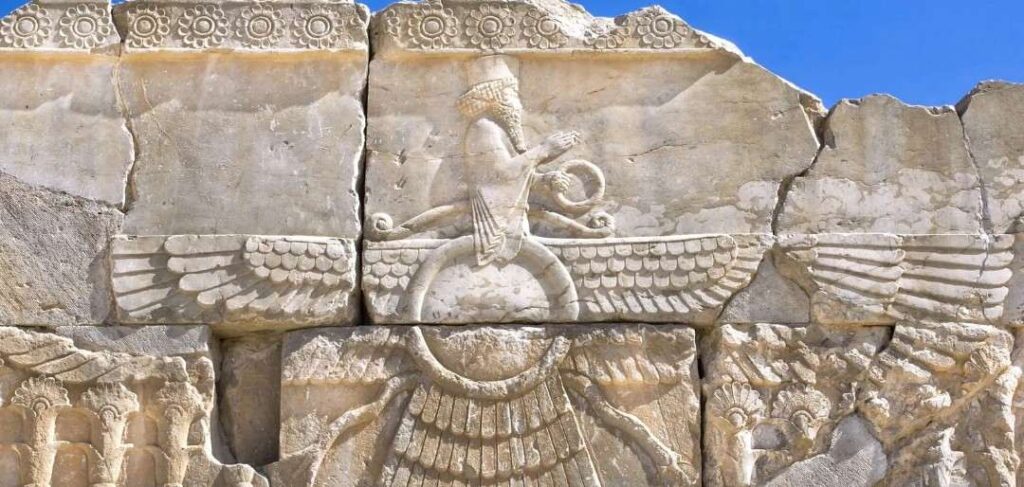
The ruins of Persepolis, the ceremonial capital of the Achaemenid Empire, rise from the Marvdasht Plain in modern-day Iran like a skeletal echo of colossal ambition. This magnificent complex, a testament to the power and artistry of a civilization that once spanned three continents, was brought to a catastrophic end by the flames of conquest in 330 BC. While the monumental staircases, the soaring doorways, and the bas-reliefs detailing ancient tributes speak volumes of the empire’s grandeur, it is a single, humble piece of stone that captures the imagination with the rawest intensity: an unfinished column capital.
This stone, resting precisely where its sculptors left it over 2,300 years ago, is more than a relic; it is a silent witness to the very moment history paused. It is a tangible link to the final hours of the great city, a rough, unpolished scar that tells the story of ambition interrupted by the swift and brutal advance of Alexander the Great. This essay delves into the profound historical, artistic, and emotional significance of this singular artifact, exploring its role as a keyhole into Achaemenid craftsmanship, a symbol of imperial fragility, and an eternal lesson preserved in stone.
A Tapestry of Stone: Persepolis and Achaemenid Artistry
To understand the unfinished capital, we must first appreciate the scale of the project it was meant to complete. Persepolis, meaning “the city of Persians,” was not a mere administrative center but a grand ceremonial capital—a spectacular stage for the New Year festival (Nowruz) and the display of imperial might. Begun by Darius the Great around 515 BC and expanded by his successors, Xerxes I and Artaxerxes I, the complex was a fusion of architectural styles, drawing influence from the diverse subject nations of the empire—Greece, Egypt, Mesopotamia, and Elam—yet synthesized into a wholly unique and distinctly Persian aesthetic.
The most iconic features of Persepolis are its hypostyle halls, massive audience chambers characterized by an extraordinary number of towering columns. The Apadana (the great audience hall), for example, was supported by 72 columns, each nearly 20 meters (65 feet) high. The very scale of these columns was a statement of power, but it was their capitals—the crowning elements of the shafts—that defined their magnificence.

The Signature Achaemenid Column Capital
The Persian column capital is arguably the most recognizable and inventive element of Achaemenid architecture. Unlike the relatively simple Doric, Ionic, or Corinthian orders of the Greek world, the Achaemenid capitals were complex, multi-tiered creations. They typically featured:
- A Campanula Base: An inverted bell-shaped element often adorned with stylized palm leaves.
- Volutes (Double Scroll): Paired scroll elements that provided structural support and visual flourish.
- The Protome: The crowning, most distinctive feature, consisting of the forequarters of two addorsed (back-to-back) animals, most commonly bulls (the protome), but also lions or griffins. These protomes supported the massive roof beams resting between their heads, creating an elegant and structurally sound system.
The sheer difficulty of carving these capitals cannot be overstated. They were immense, monolithic blocks of stone, often weighing several tons. The process required a highly coordinated team: quarrymen to extract the stone, transport specialists to move it up the terrace, and, finally, the master masons whose precise, patient hands would transform the rough block into a finished work of art. The quality and uniformity across the hundreds of finished columns testify to the unparalleled organization and skill of the Persian imperial workshops.
The Moment History Paused
The unfinished column capital rests on its original pedestal, likely in the massive Hall of Hundred Columns (also known as the Throne Hall), or a similar structure still under construction at the time of the invasion. Its presence is a unique archaeological gift, offering a direct lesson in the Achaemenid carving process.
A finished capital shows the final, polished result: smooth surfaces, razor-sharp lines, and deep, defined details on the bull protomes. The unfinished capital, however, shows the intermediate stage—the architectural blueprint translated into three dimensions, captured forever in the rough-hewn stone.
A Glimpse into the Workshop

The evidence of the artisans’ work is clear on its surface:
- The Blocking-Out: The general shape of the capital—the bell, the volutes, and the double-bull form—has been roughed out. The stone has been reduced from its original, massive cubic block to the basic architectural volume.
- The Guide Lines: Scholars can observe the faint score marks and pilot holes that the masons used to guide their chisels. These lines represent the geometric precision fundamental to their craft, ensuring symmetry and proper proportion.
- The Unfinished Detail: Crucially, the fine details are missing. The bulls’ horns, eyes, and musculature are barely indicated. The characteristic fluting on the neck of the capital is absent. The surfaces are still marked by the rough strikes of the heavy-duty carving tools. Awaiting the delicate work of the finer chisels and the final polishing (often using abrasives like emery). That would have lent the stone its lustrous finish.
This capital was not abandoned due to a mistake or fatigue. It was abandoned mid-strike. The tools, perhaps even the apprentices themselves, may have been scattered by the sound of approaching armies. The silence that fell over the courtyard on that day was a silence not of rest, but of fear and finality. The stone embodies the frozen instant before the chisel could be raised again.
The Catastrophe of 330 BC
The figure of Alexander III of Macedon (Alexander the Great) is inextricably linked to the “strange fact” that the column capital remained immobile. His campaign to conquer the Achaemenid Empire culminated in his entry into Persepolis in early 330 BC.
The destruction of Persepolis remains one of the most controversial acts of Alexander’s career. By all accounts, he did not merely occupy the city; he had it systematically looted and burned. The flames that engulfed the wooden-beamed roofs and cedar ceilings were so intense that the immense stone columns cracked and crumbled. And even the surviving stone walls were bleached and scarred by the heat.
Why the Destruction?

Historians debate the motivation behind Alexander’s command:
- Revenge: The prevailing theory, often cited by ancient sources, is that the burning was an act of vengeance for the Persian destruction of Athens during the Greco-Persian Wars (specifically Xerxes’ burning of the Acropolis in 480 BC). Alexander was symbolically settling a debt on behalf of the Greek world he had united.
- Symbolic Annihilation: By destroying the ceremonial heart of the empire—a place of unparalleled Persian pride and architectural genius—Alexander was making an unambiguous statement that the Achaemenid dynasty was over. This was not merely a military victory; it was the final, devastating act of cultural and political supremacy.
- A Moment of Intoxication: Plutarch and others mention a story that Alexander ordered the burning during a drunken revelry, possibly incited by an Athenian courtesan named Thais. While dramatic, this narrative may serve to temper the image of a calculating general. Suggesting the act was impulsive rather than purely strategic.
Whatever the immediate cause, the result was the same: the swift, violent death of a city. For the artisans working on the capital, this was the moment their labor ceased to matter. The empire was in ruins; the future of the hall they were building was ash.
The Fragility of Empire and the Power of the Unfinished
The power of the unfinished capital rests heavily on its stark contrast with the rest of Persepolis. Everything else is a portrayal of completeness, order, and triumph.
The unfinished capital, however, is a counter-narrative. It is a profound, non-verbal acknowledgment of fragility.
Art and Imperfection

In the Western tradition, Michelangelo’s unfinished non-finito sculptures are revered. For showing the struggle of the artist to release the form from the stone. At Persepolis, the unfinished capital serves a similar, though far more dramatic, function. It reveals the human hand behind the divine image of the King. It reminds us that behind the imperial decree and the architectural vision were human beings—masons, laborers, and sculptors. Whose work and lives were as subject to the whims of war as the grand halls they were building.
The raw stone is a memorial to human endeavor and its limits. It signifies:
- The Interruption of Labor: It demonstrates that the work of the Achaemenid Empire was ongoing, vibrant, and alive right up to the very moment of its collapse. This was not a slow decline; it was a sudden, violent end.
- The Vanity of Ambition:In just a few days, war and destruction undid all the planning, resources, and genius that built a city for eternity.
The capital stands as a monument to hubris, the ancient lesson that no human creation, no matter how great. Is immune to the forces of time and destruction.
A Connection to the Past
For the modern visitor, the capital offers a unique opportunity for empathy. Standing before the finished bull protomes on the Apadana columns, one marvels at the distant skill of a forgotten civilization. Standing before the unfinished block, one can imagine the hot sun. The ringing sound of the hammer on the chisel, and the voice of the foreman. A direct, human connection across 23 centuries. The hand-marks on the stone are the last physical testament to the people who were there. Building, just before the world they knew ended.
An Eternal Lesson in Stone

Today, the entire site of Persepolis is a UNESCO World Heritage site, and the unfinished column capital remains one of its most poignant features. It is a powerful archaeological marker, a chronological fixed point that provides concrete evidence of the empire’s final moment.
The capital is a testament to the fact that sometimes, the incomplete is more eloquent than the complete. A finished column is a masterpiece of design; an unfinished column is a masterpiece of history. It is a philosophical stone, prompting reflection on themes far grander than architecture: the cyclical nature of power. The devastation of conquest, and the enduring human impulse to create beauty and order even in the face of inevitable chaos.
It has never been moved, never been finished, and never been removed from its base. Allowing scholars and tourists alike to stand in the precise spot where a master mason’s final work was decreed. Not by the King of Kings, but by the fire of an invader. The rough, mute stone remains. An eternal reminder of the day when the hammer fell silent, and the mightiest empire the world had yet known breathed its last. Its story is not one of a building completed, but of a project suspended forever. A perfect image of the moment the great Achaemenid dream became an everlasting ruin.
ALSO READ: Hattusa: The Lost Capital of the Hittite Empire in North-Central Türkiye