In the summer of 1934, deep in Wyoming’s rugged San Pedro Mountains, two gold prospectors blasted open a cave and stumbled upon one of the most perplexing discoveries in American archaeology—a tiny, perfectly preserved mummy sitting cross-legged as if frozen in meditation. This remarkable find, nicknamed “Pedro,” captivated scientists, enthusiasts, and storytellers alike. Over the next decades, Pedro’s story would traverse the boundaries between science and legend, disappearing into mystery by mid-century.
Discovery in the San Pedro Mountains
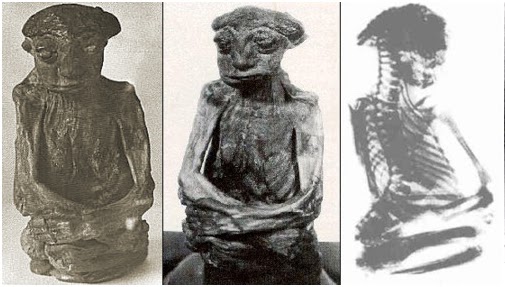
According to historical records and affidavits, gold prospectors Cecil Mayne and Frank Carr unearthed the mummy after using dynamite to open a small rock chamber in the San Pedro Mountains of Carbon County, Wyoming. Inside the four-foot-high cavern, perched on a ledge, was a diminutive figure—no taller than 6 to 7 inches seated, with an estimated height of 14–17 inches when standing.
The initial shock of the find was intensified by the figure’s startlingly human features. Wrinkled brown skin, nails on each hand, a flattened skull, bulging eyes, and tiny sharp teeth painted an eerie portrait that seemed more adult than infant. Rumors spread quickly that the miners had discovered a long-lost race of miniature humans known in Native American folklore as the Nimeriga, the legendary “little people” of the plains.
Native Legends and the Nimeriga Myth
Long before Pedro’s discovery, Native American tribes in the region—including the Shoshone and Crow—told stories about the Nimeriga, small but powerful beings known for both wisdom and ferocity. According to oral traditions, these beings lived in the mountains and could use supernatural powers for healing or destruction depending on how they were treated.
The Nimeriga were said to possess the abilities of shapeshifting and spirit communication. Some stories described them as protectors, while others warned of their vengeance against intruders who defiled sacred lands. The tale of Pedro seemed to breathe life into these ancient legends, creating a cultural bridge between folklore and apparent physical evidence.
Early Scientific Examination
After the miners sold the mummy, Pedro became a local sensation. By 1936, he was displayed in the window of a drugstore in Meeteetse, Wyoming, where postcards of the tiny figure were sold to curious visitors. Soon, scientists and anthropologists were drawn to investigate.
X-rays performed at the Field Museum of Natural History in Chicago and verified by experts at Harvard University and the American Museum of Natural History concluded that the mummy was genuine and not fabricated. However, researchers were divided on what Pedro truly was.
Some anatomists insisted the mummy was an adult of unknown origin, pointing to his worn teeth and skeletal structure. Others proposed that Pedro was a child—or even an infant—suffering from anencephaly, a congenital condition in which the skull and brain fail to develop properly.
The latter theory became the scientific consensus in later years, supported by comparative studies and radiographic data that matched Pedro’s proportions and cranial morphology with those of an anencephalic infant.

A Sideshow Sensation
While scientists debated, Pedro’s fame spread across the American West. His image appeared in newspapers, touring exhibitions, and roadside attractions.
Floyd Jones, a Meeteetse druggist, bought Pedro and displayed him under glass as part of a traveling show. Visitors paid to see “the little mummy of the mountains”—a supposed relic of a lost tribe, perhaps thousands of years old. Jones later sold Pedro to Ivan T. Goodman, a Casper-based businessman fascinated by oddities and curiosities.
Goodman’s promotional posters were colorful and extravagant, boasting: “It’s educational! It’s scientific! It will amaze and thrill you!” But behind the spectacle, the question of Pedro’s origin remained unsettled.
X-Ray Analysis and Conflicting Conclusions
When Goodman consulted Dr. Paul Martin of the Field Museum, further X-rays were taken. The results reinforced that Pedro was indeed biological—not a hoax—but they deepened the puzzle. The scans revealed a fully formed spine, ribs, and limbs, yet an underdeveloped skull. Some believed this indicated deliberate cranial flattening, a practice known among ancient cultures, while others maintained it supported the anencephaly diagnosis.
The mummy’s estimated age and carbon-dated remains suggested he was over 200 years old, placing his death around the early 1700s. However, without direct DNA testing—impossible after Pedro’s disappearance—many questions lingered.
The Disappearance of Ivan Goodman and Pedro
By 1950, Pedro had fallen into the hands of Goodman, who reportedly transported it to New York for additional research or to negotiate a sale with a scientist or collector. Shortly after the trip, Goodman suffered a fatal illness and died in Denver during brain surgery.
Pedro, however, did not return. Some accounts suggest Goodman loaned it to a New York businessman named Leonard Wadler, who exhibited the mummy privately until the mid-1970s. Upon Wadler’s death in 1980, the trail went cold.
To this day, Pedro’s location remains a mystery—possibly lost in a private collection or destroyed through neglect. Researchers have since searched for decades, offering even monetary rewards for its recovery, but the mummy has never resurfaced.
Was Pedro Human or Mythic?

The legend of Pedro invites profound anthropological debate. Could such a tiny, seemingly adult figure represent an unknown hominid species? Or was it simply the tragic remains of a Native American child born with a rare defect?
Modern researchers now overwhelmingly conclude that Pedro was an anencephalic infant whose natural mummification was aided by the cave’s dry conditions. The same conclusion was reached regarding a second, similar mummy dubbed “Chiquita,” discovered in the region in the 1990s. Genetic and morphological tests on Chiquita confirmed it as Native American, dating around 1700 CE—likely of related heritage to Pedro.
Still, the Nimeriga legends endure, bolstered by uncanny synchronicity—the discovery of a tiny humanoid mummy exactly where tribal elders had claimed such beings once lived.
A Lost Artifact, a Living Legend
Pedro’s disappearance only amplified his myth. The combination of mystery, science, and folklore transformed him from a scientific oddity into an American legend. Writers, paranormal enthusiasts, and archaeologists continue to revisit the tale, some arguing that Pedro embodies humanity’s fascination with the border between myth and reality.
Without the physical specimen, definitive conclusions remain elusive. The only existing evidence—photographs, X-rays, affidavits, and witness testimonies—preserve the mummy’s legend, allowing new generations to speculate about his origins.
The Pedro Mummy in Modern Pop Culture
In the decades following his disappearance, Pedro inspired countless retellings. Documentaries, including episodes of Unsolved Mysteries and The UnXplained, have revisited the case, blending verified data with folkloric intrigue.
Articles from outlets like Cowboy State Daily and Ancient Origins note how Pedro represents the convergence of science and storytelling that defines much of American folklore. Even modern social media platforms continue to share his tale, often accompanied by claims of hidden races or lost tribes.

In Wyoming, Pedro remains an unlikely state legend—a symbol not only of mystery but of how discoveries can echo through culture long after their loss.
What Modern Science Says
The consensus among researchers today is that Pedro’s small frame and cranial deformities are consistent with anencephaly. A congenital disorder caused by incomplete neural tube development. The preservation of muscular tissue and fingernail growth indicates rapid desiccation, likely due to Wyoming’s arid mountain climate.
The belief that Pedro’s remains were those of a “tiny adult” stemmed from early 20th-century fascination with pseudoanthropology and unexplored species theories. A trend that paralleled popular hoaxes like the Piltdown Man.
Yet Pedro’s case differs in one crucial aspect: X-rays verified his authenticity. He was no fabrication, but a genuine human body—tragic, natural, and profoundly mysterious.
The Legacy of Pedro and the Nimeriga
Though lost for over seven decades, Pedro’s legacy endures in multiple forms. For the scientific community, he exemplifies the importance of preservation ethics and accurate anthropological interpretation. And For Native American cultures, he continues to symbolize a deep connection between myth, identity, and the sacred lands of Wyoming.
For the general public, Pedro remains a reminder of how even the smallest discoveries can reshape our understanding of history. Hidden in the annals of time, he bridges two worlds—the rational and the mythical, science and story.

Could Pedro Ever Be Found Again?
If Pedro were rediscovered today, his remains would almost certainly fall under the Native American Graves Protection and Repatriation Act (NAGPRA). Ensuring respectful handling and potential return to affiliated indigenous tribes.
Given the mummy’s last verified location was in Goodman’s possession before 1950. Recovery efforts would depend on tracing private estate inventories, auction records, or family archives that may have unknowingly safeguarded him.
Until such evidence surfaces, Pedro’s whereabouts—and his final fate—remain unknown.
Conclusion: The Enduring Enigma of Pedro
The tale of Pedro, the San Pedro Mountains mummy, embodies humanity’s endless curiosity about our origins and the thin veil between fact and legend. Whether he was a tiny adult, a sadly deformed infant. Or a spiritual messenger of the Nimeriga, Pedro’s impact extends far beyond his physical remains.
He represents a singular crossroad where frontier discovery meets indigenous legend, and where science confronts the unknown. In the windswept canyons of Wyoming, Pedro’s story still whispers from the granite. An echo of the mysteries that endure in the spaces between belief and truth.
ALSO READ: The Haunting Mystery of the Kayhausen Boy: Ritual Sacrifice or Ancient Tragedy?