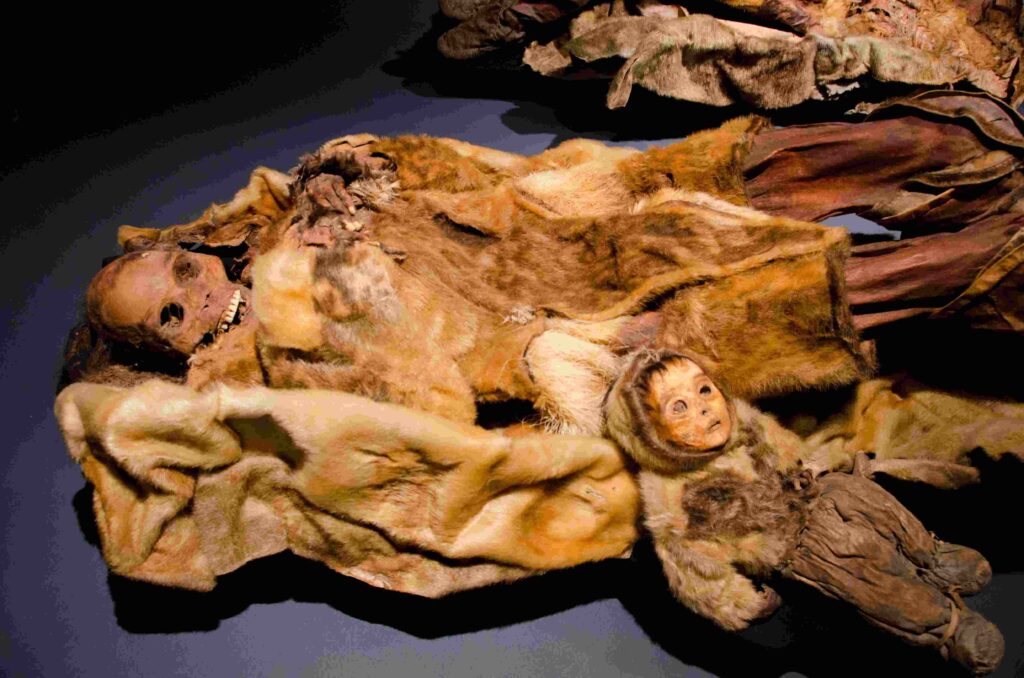
In 1972, a chilling discovery was made in the icy cliffs of northwest Greenland. Two brothers hunting in the remote settlement of Qilakitsoq stumbled upon what they first thought were recently dead bodies. Their skin was still smooth, their fingernails visible, and even their tattoos had survived the centuries. But what they had found were not modern remains—they were 500-year-old mummies.
The Qilakitsoq mummies of Greenland remain one of the most significant archaeological finds of the North Atlantic region, offering a detailed, frozen snapshot of the lives, deaths, and culture of the Inuit people in the late 15th century.
Discovery in the Frozen North
The story began on a bitterly cold day in 1972 near the deserted Inuit settlement of Qilakitsoq, located along the Uummannaq Fjord in northwestern Greenland. Two Greenlandic brothers, Hans and Jokum Grønvold, were on a routine hunting trip when they noticed a stone-covered grave tucked into a rocky outcrop.
Brushing aside the covering, they expected to find perhaps animal bones or old tools. Instead, they were shocked to uncover well-preserved human forms wrapped in layers of sealskin and carefully arranged clothing.
At first glance, the women and children buried there seemed to have died not long ago. Skin, hair, and even eyebrows were intact. But scientific study later revealed otherwise — the burials dated to approximately 1475 CE, making them over 500 years old.
This extraordinary preservation was not the result of intentional mummification. Rather, it was an accidental miracle of nature, achieved by subzero temperatures, dry Arctic air, and the protection of permafrost rock.
The Burial Site and Its Meaning
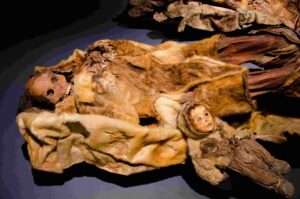
The burial contained eight individuals — six women and two children — believed to be related, possibly representing two families. Their resting place was a stone cairn nestled in a sheltered ledge, overlooking the fjord.
The arrangement of the bodies suggested careful ritual. Each was swathed in multiple layers of sealskin, embellished with furs and animal hides. This layering not only provided incredible preservation but also reflected the Inuit respect for the dead.
The site was likely chosen for its protection from predators and melting, ensuring the deceased could rest undisturbed. In the Arctic, where the ground remains frozen most of the year, digging into the earth would have been impossible; hence, stone-layered tombs were the logical alternative.
Who Were the Qilakitsoq Mummies?
Scientific studies identified the eight mummies as belonging to the Thule culture, ancestors of today’s Inuit. Radiocarbon dating and isotopic analysis placed their deaths around 1475 CE, a time when the Thule people dominated Greenland’s coastal regions.
The individuals were of varying ages:
-
Four women aged between 20 and 50.
-
Two younger women between 18 and 25.
-
One child around six months old.
-
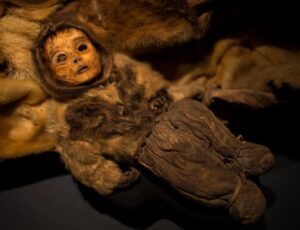
A boy approximately four years old, whose face became one of the most haunting symbols of Arctic archaeology.
Examinations suggested that some suffered from health issues such as stunted growth, joint diseases, and even Down syndrome. The presence of these ailments gave anthropologists a human insight into Inuit compassion — these individuals were cared for deeply despite hardships in their community.
The Mystery of the Infant
Among the most poignant of the Qilakitsoq discoveries is the infant bound tightly in sealskins. At first, researchers assumed it had died naturally. Later CT scans revealed that the child had been buried alive — a shocking yet culturally explainable act.
In Inuit tradition, if a mother died and no one could nurse her baby, it was sometimes customary for the community to allow the infant to die peacefully alongside her. To modern eyes, this may seem cruel, but to a people surviving in the brutal Arctic, it was an act of mercy — ensuring no one suffered prolonged starvation or exposure.
Signs of Tattooing and Adornment
Close inspection of the mummies revealed incredibly detailed tattoos on their faces — fine lines drawn in dark pigment across cheeks and foreheads. These tattoos are among the oldest surviving examples of Inuit body art, serving as powerful cultural identifiers and possibly signifying marital status, maturity, or spiritual protection.
Hair was intricately styled and even preserved with remnants of animal fat, used as a conditioner. Clothing layers — many still perfectly intact — displayed expert craftsmanship, tailored from reindeer, seal, and fox pelts stitched with sinew thread.
How Nature Preserved the Mummies
Unlike Egyptian mummification, which relied on deliberate embalming techniques, the preservation of the Qilakitsoq mummies was wholly accidental.
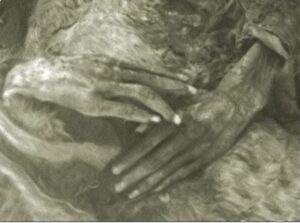
The subarctic climate created ideal natural preservation conditions:
-
Freezing temperatures halted bacterial decay immediately after burial.
-
Dry, oxygen-poor air prevented decomposition.
-
Sealskin wrappings insulated and desiccated the bodies slowly.
-
Stone layers shielded the grave from predators and meltwater.
This combination allowed not only skin but also internal organs to remain intact. Scientists performing CT scans and dissections decades later could study lung tissue, stomach contents, and even understand aspects of disease progression.
Diet and Daily Life of the Qilakitsoq Inuit
Analysis of stomach contents and isotopic traces revealed that these ancient Greenlanders lived primarily on a diet of sea mammals, fish, and seabirds. Seal fat provided essential calories in a cold environment, while intestines and fermented meats supplemented nutrition in winter.
Archaeologists also examined fibers, tools, and sewing methods from the clothing to reconstruct daily life activities such as hunting, fishing, and child care. Their community likely practiced seasonal migration, moving along fjords following wildlife patterns.
Cultural Significance of the Find
The discovery of the Qilakitsoq mummies reshaped global understanding of Arctic cultures. Before their unearthing, scientists believed that cold climates could not preserve human remains with such precision without artificial aid.
These mummies proved otherwise — nature itself could become the embalmer. More importantly, they revealed the sophistication and humanity of Inuit society, often undervalued in earlier Western narratives.
Through the mummies, researchers learned about Inuit clothing technology, artistry, kinship roles, gender-specific labor, and spiritual beliefs concerning death and afterlife.
Forensic Insights and Modern Research
In the years following their discovery, the mummies underwent detailed examination using non-invasive imaging and modern scanning techniques at Denmark’s National Museum.
Key findings included:
-
Evidence of tattooing pigments derived from soot and seal oil.
-
Presence of parasites in intestines linked to raw meat consumption.
-
Detailed pathological studies showing joint inflammation and arthritis.
-
Clear signs of malnutrition in the younger individuals.
Their extraordinary preservation turned them into subjects of global forensic study, with medical researchers learning about centuries-old diseases and Inuit adaptations to extreme environments.
The Clothing: A Masterpiece of Arctic Engineering
Each mummy was clothed in multiple layers—some wearing up to five complete outfits. The ensemble followed a system perfected by the Inuit over millennia:
-
Inner skin layer (amaq): Soft caribou or seal skin worn with fur facing inward for insulation.
-
Middle layer: A thicker hide turned fur-outward, trapping air for warmth.
-
Outer garment: Waterproof sealskin parka repelling wind and moisture.
This layering system could withstand temperatures well below freezing. The fine tailoring demonstrated deep ecological understanding — how to work with materials, manage moisture, and maintain body heat even during long hunts.
Every seam, stitch, and knot told the story of a people who mastered survival in one of Earth’s harshest environments.
The Mummies and Inuit Spirituality
In Inuit cosmology, death was not the end but a transformation within a cyclical world of spirits and ancestors. Burials like Qilakitsoq’s likely represented acts of respect and spiritual guidance.
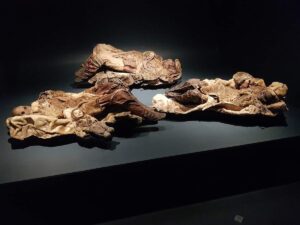
The placement of the bodies in a protected rock niche may have been intended to allow souls safe passage to the land of the dead without disturbance from animals or natural forces.
Archaeologists believe objects or amulets once accompanied the bodies, though few artifacts survived due to centuries of burial. The layering of garments, however, might itself have served a spiritual function—symbolically “wrapping” the spirit for its journey beyond life.
Comparison to Other Arctic Mummies
When compared to other mummified remains across the Arctic — such as the Aleutian Island mummies and Siberia’s Ice Maiden — the Qilakitsoq mummies stand apart for their natural preservation and completeness.
| Region | Age (Approx.) | Type | Preservation Cause | Cultural Group |
|---|---|---|---|---|
| Qilakitsoq, Greenland | 500 years | Accidental | Frozen permafrost | Thule (Inuit) |
| Aleutian Islands | 700 years | Intentional | Air-drying and wrapping | Aleut |
| Siberian Altai | 2,500 years | Intentional | Ice and embalming | Pazyryk Scythians |
The Qilakitsoq find demonstrated that accidental preservation could yield equally rich anthropological data as intentional mummification.
Life and Death in 15th-Century Greenland
During the time these individuals lived, Greenland’s Inuit people thrived in small coastal settlements, hunting sea mammals and navigating treacherous fjords by kayak and umiak.
Climate conditions in the late 1400s — approaching the Little Ice Age — were turning colder, making hunting more dangerous and food scarcer. These hardships were reflected in the health of the mummies: worn teeth from chewing hides, arthritic joints from long labor, and malnutrition caused by harsh winters.
Yet their finely made garments and loving burial arrangements reveal dignity and resilience. They were not victims of neglect but participants in a close-knit community bound by survival, compassion, and cultural identity.
Where the Qilakitsoq Mummies Rest Today
After excavation, the mummies were carefully transported to the National Museum of Denmark in Copenhagen, where they underwent extensive study. Today, replicas and photographic exhibits educate visitors on Inuit heritage and ancient Arctic life.
In keeping with modern ethical and cultural standards, cooperation with Greenlandic Inuit communities was integral to the handling and curation of the remains. Many locals regard the mummies with deep reverence, seeing them not as museum specimens but as ancestors who continue to tell their story across generations.
Legacy and Ethical Reflection
The Qilakitsoq discovery invites reflection on the line between scientific inquiry and cultural sensitivity. For many Inuit, these individuals are more than archaeological material—they are family from the distant past.
Modern presentations emphasize this human story, blending science with spirituality to honor the mummies’ memory. Their preservation challenges viewers to question how we interpret death, time, and identity across centuries.
Technology and Future Research
Continuing studies of the Qilakitsoq remains rely on non-invasive technologies such as:
-
3D imaging and digital reconstruction, allowing precise facial models.
-
DNA sequencing identifying genetic patterns among early Arctic populations.
-
Isotopic analysis tracing migration and dietary shifts due to climate changes.
These techniques promise new insights not only into Inuit ancestry but also into adaptive strategies that may inform understanding of human resilience in extreme environments — a topic increasingly relevant in the era of climate change.
Lessons from the Frozen Past
The Qilakitsoq mummies offer more than scientific fascination; they reveal a timeless human story about survival, adaptation, and care for one another.
Despite the merciless Arctic world they inhabited, the people of Qilakitsoq displayed creativity, empathy, and resourcefulness. Their story demonstrates how love and community persisted even amid cold, hunger, and mortality.
Today, these mummies stand as silent ambassadors of Inuit history — frozen voices whispering across five centuries of snow and silence.
Conclusion: A Window Into Humanity’s Resilience
From a remote cliffside grave came one of archaeology’s most moving discoveries — not golden artifacts or royal tombs, but the preserved lives of ordinary people.
The Qilakitsoq mummies show that greatness in history is not always measured in monuments but in memory — in how a small group of humans, long gone, can still remind us of endurance, tenderness, and the shared threads of human experience that survive even the coldest ages of time.