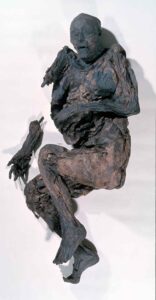
In the quiet peatlands of northern Germany, a peat cutter’s blade struck something that would forever echo through the annals of archaeology. The year was 1922, and beneath layers of millennia-old sphagnum moss lay the preserved body of a young boy—tentatively aged between seven and ten years—his limbs bound, his neck slit, and his story forever sealed within the amber grip of the bog. Known today as the Kayhausen Boy, his discovery revealed both the extraordinary preservation of Iron Age remains and the chilling rituals practiced by ancient Europeans.
The Discovery in Kayhausen: Unearthing an Ancient Child
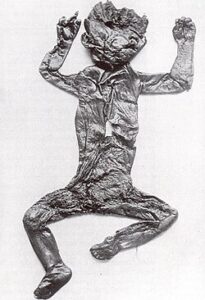
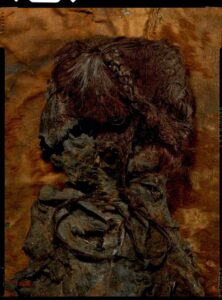
In 1922, near the village of Kayhausen in Lower Saxony, Germany, local workers cutting peat for fuel stumbled upon a human figure beneath the dense, dark peat. This was no skeleton—it was a body with skin, hair, and even fragments of fabric and fur still attached. The bog’s chemistry, acidic and oxygen-poor, had mummified the child naturally, freezing him in time.
Examinations dated his death to approximately 300–400 BCE, the Early Iron Age. The boy’s body was carefully bundled in woolen fabric and a calfskin cloak, with rough bindings around his arms and legs. When the remains reached the Natural History Museum, investigators were stunned by the deep stab wounds—three to the neck and one to the arm—that told a terrible story of violence and struggle.
Bog Bodies and Their Strange Preservation
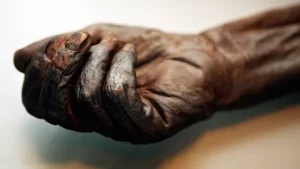
Bogs across northern Europe have yielded hundreds of mysterious corpses known as “bog bodies”—natural mummies preserved in peat. The unique environmental conditions—low temperatures, absence of oxygen, and tannic acids—prevent decay, allowing everything from skin texture to stomach contents to survive for millennia.
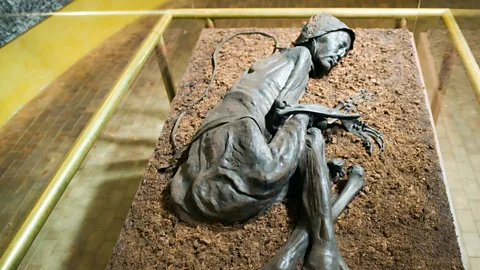
Examples such as Tollund Man, Grauballe Man, and Yde Girl all reveal a perplexing pattern: these individuals often met violent ends, their bodies deposited purposefully in wetlands. Archaeologists now interpret bog burials as spiritual or ritualistic acts, where the bogs themselves served as sacred gateways between the world of the living and the divine.
Forensic Findings: Clues from the Body
Wounds and Weapons
The Kayhausen Boy was stabbed repeatedly in the throat, each cut about 3–4 cm deep—fatal wounds that caused almost immediate death. A fourth wound on his left forearm suggested a defensive gesture, as though he instinctively raised his arm to protect himself.
The weapon used was likely a short dagger—its iron or bronze blade about four centimeters long—consistent with Iron Age tools and ceremonial weapons.
Disease and Disability
X-rays revealed a severe infection of the femoral hip socket, likely making it impossible for the boy to walk unaided. Anthropologists have noted similar conditions among other bog bodies and hypothesize that disabled or ill individuals may have been chosen for sacrifice as offerings to the gods or as ritual scapegoats for community misfortune.
The Bonds That Bound Him
His body was wrapped tightly: arms and legs constrained by torn clothing and fur hide. Some interpretations suggest these bindings were designed not only to restrain but also to create agonizing tension if the boy struggled—a cruel feature echoed in accounts of ritual execution across Iron Age Europe.
Theories Surrounding His Death
The Ritual Sacrifice Hypothesis
Many scholars interpret the Kayhausen Boy’s death as a ritual killing. The Iron Age peoples of northern Europe, including Germanic and Celtic tribes, often associated wetlands and bogs with divine or liminal spaces. Sacrifices—of animals, weapons, and humans—were offered to gods who dwelled in these watery thresholds.
The precise and deliberate nature of the wounds, the bindings, and the careful placement of the body all align with religious offerings rather than random violence. In times of famine, disease, or war, ancient clans may have sought to appease their gods through human life—perhaps believing that a young, untainted soul would be a worthy gift.
The Social Retribution Theory
An alternative view holds that the Kayhausen Boy’s death was punitive or communal. In some tribal societies, children with deformities or chronic illnesses were believed to embody misfortune or curses. Such individuals might be ritually punished to cleanse the tribe or restore balance.
Others propose that his injuries resulted from judicial execution or community violence, explaining his defensive wound as a sign of resistance. The bog may then have served as a symbolic grave, chosen to conceal or sanctify the crime.
The Mercy Killing Hypothesis
A more compassionate interpretation suggests that the boy’s immobility and chronic pain from infection led his caretakers to perform a mercy killing, with ritual formalities giving symbolic dignity to an otherwise tragic act.
Cultural and Religious Context: Why Bogs?
The reverence for bogs in northern Europe extended far beyond practicality. To Iron Age peoples, bogs were liminal realms, sitting between earth and water, life and death, mortal and divine.
Depositing a human body into the bog was not casual disposal—it was an act of transition. The body was offered to nature’s depths, returning to the cycle of fertility, death, and rebirth believed to govern the cosmos.
Such practices spanned Denmark, Ireland, the Netherlands, and Germany, revealing a shared spiritual ideology that linked waterlogged sacrifice to divine communion.
Comparisons to Other Bog Bodies
| Bog Body | Location | Estimated Date | Cause of Death | Possible Interpretation |
|---|---|---|---|---|
| Kayhausen Boy | Germany | 300–400 BCE | Stab wounds to neck; bound limbs | Ritual sacrifice or punishment |
| Tollund Man | Denmark | 400 BCE | Hanging | Human sacrifice to fertility goddess |
| Yde Girl | Netherlands | 50 BCE | Strangulation; facial disfigurement | Ritual killing of a young woman, possibly punished |
| Grauballe Man | Denmark | 290 BCE | Throat cut ear-to-ear | Religious offering |
| Lindow Man | England | 60 CE | Bludgeoned, strangled, and throat cut | Theatrical tri-part sacrifice |
The Kayhausen Boy stands out among these examples because of his tender age and the combination of disease, disability, and violence—indicating a complex interplay of compassion, fear, and faith unique to his case.
A Child in the Iron Age: Life and Society
Children in Iron Age communities were valued as lineage carriers but also as vessels of purity. Ethnographic parallels suggest that child victims might have been seen as messengers to the gods, embodying innocence while representing noble sacrifice.
Daily life in the period around 400 BCE was harsh. Settlements in northern Germany relied on subsistence farming, animal husbandry, and seasonal trade. Disease, malnutrition, and superstition were interwoven realities. The Kayhausen Boy’s Harris lines—growth interruptions visible on his bones—reveal he suffered nutritional stress, a common condition among lower-status families.
In this socio-religious environment, the line between sacred offering and social exclusion was tragically thin.
Archaeological Examination Over the Decades
The boy’s remains have undergone repeated study throughout the 20th and early 21st centuries. Early examinations relied on gross anatomy, but recent forensic and CT imaging. Provided detailed reconstructions of bone trauma, tissue preservation, and pathology.
-
Microscopic analysis confirmed wounds made by a blade sharpened to a fine edge, not a jagged tool.
-
Pollen and sediment analysis identified springtime vegetation in the bog, suggesting he was killed and deposited around late March to early April—possibly tied to seasonal fertility rituals.
-
Textile studies found that the wool fabrics used to bind the body were consistent with regional weaving styles of northern Germany during the Iron Age.
Researchers keep the body in a climate-controlled archive for ongoing study because, even though they have preserved it in a formalin solution, it remains too fragile for display.
The Symbolism of the Kayhausen Boy
The imagery of a bound, slain child preserved in earth and peat resonates beyond archaeology. The Kayhausen Boy embodies themes of innocence, devotion, and fear—a microcosm of humanity’s struggle with mortality and meaning.
Modern anthropologists interpret his case through the lens of liminality—the transitional phase between states of existence. The bog, like death itself, suspended him between worlds: not buried in soil, not cremated, but offered to eternity through preservation.
Parallels in Myth and Ritual
Northern European mythologies teem with stories of sacrificial youths, divine appeasement, and ritualized death. The Celtic Tarvos Trigaranus myth, the Norse Vanir sacrifices, and Germanic fertility rites involving effigy burning all echo similar patterns: violence intertwined with veneration.
The boy’s death may have mirrored local cosmological cycles—springtime death to ensure summer fertility—aligning him symbolically with the rebirth of nature each year.
Ethical and Emotional Reflections
Modern audiences naturally recoil at the notion of a child sacrificed for spiritual or communal needs. Iron Age societies wove life and death into an ecological and divine balance.
Archaeologists strive to approach the Kayhausen Boy not as a victim sensationalized. By tragedy but as a participant—willing or otherwise. In an ancient cultural narrative of faith, survival, and reverence.
His remains, silent yet eloquent, remind us that the boundaries of morality shift with time—yet empathy bridges all eras.
The Kayhausen Boy’s Legacy in Modern Archaeology
The case of the Kayhausen Boy continues to influence forensic archaeological methodology. His study reinforces how interdisciplinary approaches. Combining radiography, paleoepidemiology, textile analysis, and forensic anthropology—can illuminate both human biology and belief.
Comparative studies with other bog bodies suggest that ritualized violence was ceremonial rather than random. Forming a cohesive pan-European Iron Age phenomenon.
Furthermore, his story fuels discussions about cultural relativism and ethical exhibition. Raising questions about how ancient human remains should be preserved and interpreted today.
Conclusion: The Boy Who Would Not Decay
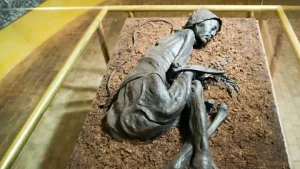
More than two thousand years after his death, the Kayhausen Boy persists as one of archaeology’s most haunting enigmas. His body, preserved against time, tells of violence but also of reverence. An echo of a civilization that sought meaning in sacrifice and eternity in peat.
Whether victim, offering, or symbol, he bridges the gulf between ancient spirituality and modern empathy. Immortalized not by myth but by science—a life remembered through the earth that refused to let him go.
ALSO READ: The Qilakitsoq Mummies of Greenland: Frozen Echoes of Inuit Life From 500 Years Ago