Hidden for millennia beneath the rugged hills of southeastern Turkey, Karahan Tepe has emerged as one of the most extraordinary archaeological discoveries of the 21st century. Unearthed in the Şanlıurfa Province and first identified in 1997, this monumental site pushes the boundaries of what we know about early human civilization, revealing that hunter-gatherer societies long before agriculture were capable of astonishing artistic and architectural achievements.
The Dawn of Monumental Civilization
When Karahan Tepe was first brought to scholarly attention, it seemed an unassuming mound among many in the Anatolian landscape. Yet, beneath layers of soil lay a prehistoric complex that could transform our understanding of early social development. Dating to around 10,000 to 9,500 BCE, Karahan Tepe stands alongside its sister site, Göbekli Tepe, as part of a regional network known collectively as Taş Tepeler—“Stone Hills.” Together, these sites represent some of the earliest evidence of monumental construction and organized ritual activity by hunter-gatherer communities.
Karahan Tepe’s significance lies not just in its age but in what it reveals about the intellectual and social world of early humans. The site’s vast T-shaped pillars, intricate carvings, and carefully planned enclosures show that long before farming, people were already building sacred spaces that embodied their beliefs, cosmology, and social bonds.
Historical Context and Discovery of Karahan Tepe
The story of Karahan Tepe begins in 1997 when archaeologist Bahattin Celik discovered the site near the modern village of Yağmurlu in southeastern Turkey. At first, little excavation occurred; much of the mound remained buried beneath centuries of sediment. Only when full-scale excavations resumed in 2019 under the leadership of Professor Necmi Karul of Istanbul University did the extent of Karahan Tepe’s importance become clear.
The site belongs to the Pre-Pottery Neolithic period, a transformative era when human societies were transitioning from mobile hunter-gatherer lifestyles toward more sedentary communities. However, Karahan Tepe challenges the traditional sequence of this transition. It demonstrates that complex social organization and monumental architecture preceded agriculture—not the other way around.
The Taş Tepeler Cultural Landscape
Karahan Tepe is one of more than a dozen prehistoric mound sites stretching across southeastern Turkey. Collectively called the “Taş Tepeler,” these sites share distinctive traits: monumental T-shaped pillars, circular architecture, and intricate animal reliefs. Together, they form a cultural landscape that spans over 200 kilometers, marking Upper Mesopotamia as a cradle of early symbolic civilization.
While each site has distinct architectural features, they all display a unified symbolic language emphasizing human-animal interactions, cosmic cycles, and fertility motifs—indicating a shared ideological system among regional communities.

Excavation Efforts and Archaeological Leadership
Under the management of the Şanlıurfa Archaeology Museum and guided by Necmi Karul’s team, Karahan Tepe has become one of Turkey’s most intensively studied prehistoric sites. Excavations have revealed that the archaeological layers extend deep into bedrock chambers and rock-cut enclosures, many of which appear deliberately filled and sealed in antiquity.
Only about five percent of the site has been excavated, yet discoveries include carved human faces, massive T-shaped columns, seated anthropomorphic statues, and quarry marks showing in-situ pillar production. The extent of preservation is remarkable, mainly because Karahan Tepe, like Göbekli Tepe, was intentionally backfilled around 8,000 BCE. This deliberate burial preserved structures and reliefs in near-original condition, allowing archaeologists an unprecedented window into early human creativity.
The Architectural Marvel of Karahan Tepe
Layout and Scale
Spanning roughly ten hectares, Karahan Tepe’s primary architectural complex consists of interconnected circular and oval enclosures carved directly into the bedrock. Surrounding these are platform areas, passageways, and working zones that together form a coherent architectural plan unprecedented for its time.
Besides the main excavation zone, an adjacent five-hectare quarry field reveals where ancient builders extracted and shaped limestone for pillars and benches. The organization of quarry zones, construction areas, and arranged enclosures suggests a large, coordinated workforce that operated under shared ritual or communal goals.
The T-Shaped Pillars: Symbols of Power and Presence
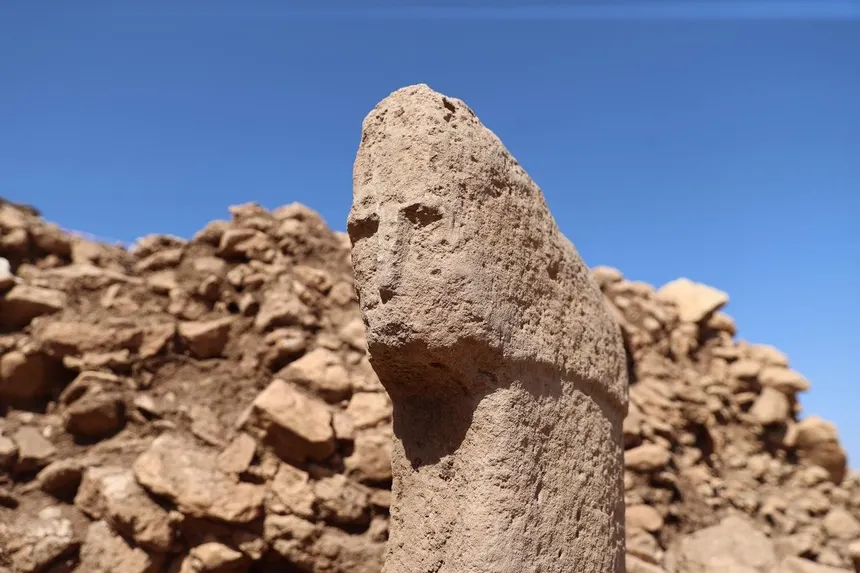
The hallmark of Karahan Tepe’s architecture is its forest of T-shaped pillars—massive monoliths standing up to several meters tall. Over 250 have been identified so far, each carved from local limestone. These pillars are anthropomorphic, with the horizontal “head” slab suggesting shoulders and the vertical shaft representing a stylized human torso.
Many pillars bear detailed reliefs of animals—foxes, snakes, wild cats, vultures, and boars—all rendered in a naturalistic but symbolic style. Some also include human anatomical features like ribs, hands, and even facial details—rare in Neolithic art. Such representations blur the boundaries between human, animal, and spiritual realms, expressing a cosmology where life forms and spiritual entities intertwined.
Iconic Sculptures and Symbolic Artistry
Perhaps the most striking discovery at Karahan Tepe is a life-sized seated male statue over two meters tall. The figure, bald and with deeply incised features, holds his phallus in an overt symbol of fertility and regeneration. The V-shaped collar carved into his chest mirrors similar motifs on the T-pillars, suggesting a unified symbolic code connecting sculpture and architecture.
In another sector, a T-shaped pillar features a human face carved in deep relief—one of the few examples of explicitly anthropomorphic depiction in early monumental art. The presence of realistic human faces alongside abstract totemic symbols points to an emerging concept of individual identity within collective ritual contexts.
Animal figures further enhance this symbolic realm. Snakes and leopards recur often, likely representing danger, protection, or transformation. Birds such as vultures appear frequently, corresponding to Neolithic beliefs linking vultures with death and sky-borne spirits. Together, these images formed an elaborate symbolic vocabulary that predated writing but conveyed profound cultural meaning.
Architectural Planning and Stonecraft Techniques
Mastery of Stone and Space
The precision with which the builders of Karahan Tepe shaped and arranged massive limestone blocks speaks to remarkable technical skills. Archaeological evidence indicates that ancient workers quarried the stone locally, using stone hammers and flint chisels to shape pillars directly in situ. Unfinished monoliths still attached to bedrock reveal the exact production method—allowing modern researchers to reconstruct the process step by step.
The use of circular or oval arrangements aligns with Göbekli Tepe’s design principles but differs in detail. While Göbekli Tepe’s enclosures were bounded by stone walls enclosing T-pillars, Karahan Tepe’s architecture was often carved from solid limestone bedrock, creating a unique hybrid between sculpture and structural engineering.
Structural and Ritual Symmetry
Each enclosure within Karahan Tepe appears to have deliberate symmetry, possibly oriented toward celestial or ritual axes. The layout’s organization implies an understanding of geometry, balance, and communal gathering space. The pillars possibly served as spiritual mediators or representations of ancestral beings watching over ritual participants.
This design sophistication supports the idea that early Neolithic architecture was deeply symbolic. These enclosures were not dwellings but sanctuaries of belief, constructed to embody cosmological order within landscape and stone.

Symbolism, Ritual, and Spiritual Expression
The Language of Symbols
The engravings and sculptures found at Karahan Tepe suggest that these early societies used art to communicate metaphysical ideas. In the absence of written language, imagery served as a universal vocabulary. The repeated pairing of human and animal forms may represent a worldview where the boundary between species was fluid—an echo of shamanic traditions linking humans to the natural and spiritual realms.
The T-shaped pillars themselves likely symbolized divine or ancestral beings. Their human-like proportions suggest that early Neolithic communities sought to materialize sacred presence in permanent stone—a revolutionary act of projecting spiritual meaning into tangible architecture.
Cosmic Cycles and Fertility Motifs
Themes of fertility, death, transformation, and renewal permeate Karahan Tepe’s art. The male statue’s emphatic phallic element emphasizes generative power, while vulture imagery signifies death and the spirit world. This duality mirrors later Near Eastern cosmologies where life and death were seen as cyclical forces sustaining cosmic balance.
Communal Identity and Ritual Labor
Building such vast structures would have required unprecedented human cooperation. Hunter-gatherer groups from a wide region likely converged seasonally to quarry, carve, and erect the pillars. The shared labor was itself a ritual act, reinforcing social cohesion and collective identity. In this sense, Karahan Tepe was both temple and symbol—a space where community, belief, and creativity merged.
Karahan Tepe and Göbekli Tepe: Sister Sites in Stone
Architectural Parallels and Cultural Unity
Göbekli Tepe, located about 46 kilometers to the west, has long been hailed as the world’s oldest temple complex. Karahan Tepe’s revelations now suggest it may be even older. Both sites share key features—T-shaped pillars, circular architecture, and elaborately carved reliefs—yet Karahan Tepe differs in its more integrated stone-cut architecture and explicit human sculptures.
These shared traits indicate a coherent cultural tradition spanning several centuries. Rather than isolated experiments, Karahan and Göbekli Tepe were part of a connected ritual landscape, implying communication and cultural exchange among early hunter-gatherer groups across Upper Mesopotamia.
Hierarchical and Functional Differences
Archaeologists speculate that Göbekli Tepe may have served as a major regional sanctuary—a “cathedral” for widespread gatherings—while Karahan Tepe and related Taş Tepeler sites operated as smaller ritual centers or local “parish temples.” This suggests an early form of religious hierarchy and organized ceremonial network extending over vast territory, centuries before urban civilization.
Evidence of Daily Life and Early Plant Use
Although Karahan Tepe’s primary purpose appears ritualistic, artifacts hint at aspects of daily subsistence. Excavations uncovered grinding stones, pestles, and chipped stone tools—evidence of plant processing and hunting activities. While domesticated crops are absent, the presence of such tools marks the gradual shift toward proto-agriculture and sedentary living.
The blending of ritual and domestic life at Karahan Tepe challenges long-held archaeological dichotomies. It implies that spiritual belief, food production, and social order evolved together, not sequentially—each reinforcing the other in a cycle of cultural innovation.
Tools and Craftsmanship
Lithic analysis shows that site inhabitants produced finely retouched obsidian blades and limestone tools. These items suggest specialized craftsmanship and trade connections reaching volcanic regions hundreds of kilometers away. Such exchange networks underline the social complexity and wide-ranging interactions among early Neolithic communities.

Intentional Burial and Site Abandonment
Like Göbekli Tepe, Karahan Tepe was eventually buried under deliberate backfilling around 8,000 BCE. Whether this was a symbolic closure or part of a broader cultural transition remains debated. The filling preserved the stone structures remarkably, freezing them in time for discovery 10,000 years later.
The ritual sealing of such monumental centers might signify a shift in worldview—as communities adopted new lifestyles based on agriculture and settlement, they transformed their spiritual and social expressions accordingly.
Excavation Goals and Digital Preservation
Today, Karahan Tepe forms a central focus of Turkey’s Taş Tepeler Project—a long-term national initiative to document and preserve early Neolithic sites. Current excavation goals include:
-
Detailed mapping of quarry and construction zones to reconstruct ancient labor organization.
-
Radiocarbon dating and stratigraphic study to refine chronological sequences.
-
3D laser scanning and digital documentation of reliefs and structures for conservation.
-
Comparative analysis with Göbekli Tepe, Çakmaktepe, and Sayburç to reconstruct regional symbolic systems.
Digital preservation ensures that the intricate carvings and spatial layouts of Karahan Tepe can be studied globally, allowing archaeologists and historians to explore its mysteries without threatening its fragile integrity.
Implications for Human History
Rewriting the Story of Civilization
Discoveries at Karahan Tepe fundamentally reshape our narrative of human development. They demonstrate that monumental architecture and organized religion did not emerge after agriculture—as once thought—but before it. Hunter-gatherer societies, through shared belief systems and complex rituals, laid the social groundwork for later sedentary civilization.
This reversal of assumptions challenges the long-held “Neolithic Revolution” model. Instead of viewing agriculture as the cause of social complexity, Karahan Tepe suggests that social and symbolic innovation may have motivated people to settle, cooperate, and eventually domesticate plants and animals.
A New Model of Neolithic Emergence
Rather than a single revolution, the beginnings of civilization appear as a long continuum of cultural experimentation. Monumental building projects like those at Karahan Tepe required planning, cooperation, and leadership—traits central to later urban societies. Such works represent an early manifestation of organized religion and social stratification, predating cities by thousands of years.
Global Significance
Karahan Tepe’s discoveries ripple far beyond Anatolia. They challenge global archaeology to reconsider similar sites across the Near East, Levant, and even prehistoric Europe. Comparable symbolic traditions may have existed elsewhere but were never preserved or recognized due to lack of monumental form. Karahan Tepe offers a key template for understanding how spirituality evolved into civilization.
Interpreting Symbolism and Belief

Human Faces and Spirit Worlds
The human faces carved at Karahan Tepe are not mere portraits; they embody spiritual intermediaries, possibly ancestors or mythic beings mediating between worlds. The combination of abstract pillar forms and realistic human features reflects dual aspects of existence—material and transcendent.
The Union of Male and Female Forces
The prominence of phallic symbols and fertility imagery might indicate ritual concerns with regeneration and continuity. Together with potential female figurines from nearby sites, they reveal an early theology centered on balance—male vitality, female creation, and the cyclic renewal of life.
Future Research and Technological Advances
Karahan Tepe’s excavation employs cutting-edge technologies—drone mapping, photogrammetry, and stratigraphic DNA sampling. Upcoming research focuses on uncovering organic residues, pigments, and botanical traces within sediment layers, which may further clarify subsistence and ritual practices.
Modern interdisciplinary approaches combining archaeology, paleoenvironmental science, and cognitive anthropology aim to explore how symbolic thought evolved alongside social complexity. Karahan Tepe stands as a bridge between biology and belief—the moment when Homo sapiens began shaping not just tools or shelters, but meaning itself.
Tourism, Heritage, and Preservation
Karahan Tepe is gradually opening to responsible cultural tourism, supported by Turkey’s Ministry of Culture and Tourism. Visitor facilities and interpretation centers are being developed to showcase the site’s story while minimizing disturbance. As awareness grows, Karahan Tepe joins Göbekli Tepe as part of a unified heritage trail that celebrates humanity’s earliest sacred architecture.
Preservation remains a priority. Archaeologists emphasize controlled exposure to prevent erosion and damage. Through digital replication, replicas, and museum exhibits, Karahan Tepe’s fragile stonework can be shared widely without compromising authenticity.
Broader Cultural and Academic Impact
Academic Paradigm Shift
Karahan Tepe compels archaeologists to reconsider the relationship between ritual and economy. It supports the idea that communal belief systems motivated organized labor and cooperation, paving the way for agriculture, not resulting from it. This aligns with emerging cognitive archaeology models that prioritize symbolic behavior in human evolution.
Comparative Insights
Karahan Tepe invites comparison with other prehistoric sites:
-
Jericho (Palestine): Early settlement and tower-building around 9000 BCE show parallels in defensive and ritual planning.
-
Çatalhöyük (Turkey): Later Neolithic community with ongoing symbolic wall art suggests continuity in worldview.
-
Stonehenge (England): Another monumental gathering site, thousands of years later, illustrating the persistence of ritual landscapes shaped by cosmology.

What Karahan Tepe Teaches Us About Ourselves
In understanding Karahan Tepe, we confront the essence of humanity’s desire to build, believe, and belong. Long before farming or writing, people gathered to erect symbols of shared meaning. They combined art, architecture, and community in a fusion that anticipates every later civilization.
Karahan Tepe reveals that spirituality and creativity lie at the heart of what makes us human. Its silent pillars still speak across 12,000 years, telling us that the first monuments were not built for kings or gods, but for ideas—ideas about life, death, and the cosmos.
Conclusion: The Legacy of Karahan Tepe
Karahan Tepe stands as one of the world’s earliest masterpieces of human expression. Its T-shaped pillars, anthropomorphic sculptures, and stunning carvings mark a threshold in human history—a time when imagination took monumental form.
As excavations continue, each discovery deepens our insight into how hunter-gatherer peoples first conceived the sacred. The site embodies the dawn of spirituality, community, and architecture—all arising centuries before the birth of agriculture. In rewriting prehistory, Karahan Tepe reminds us that civilization began not with crops or cities, but with the human impulse to create meaning in stone.
ALSO READ: The Ruins of Hamoukar: A City Burned by Time and Bullets