A Discovery Beyond Imagination
In one of the most astonishing revelations of modern science, researchers recently announced the discovery of human DNA fragments embedded within a meteorite estimated to be over 2 billion years old. The specimen, recovered from a barren desert region under stringent contamination controls, underwent advanced genomic and isotopic analyses. The results left the scientific world speechless: genetic fragments closely resembling human DNA were detected—within a rock older than the earliest known terrestrial life.
This claim, if authenticated through independent peer review, could revolutionize our understanding of how life began. It challenges Earth-centric narratives, introduces unprecedented support for panspermia theory, and even raises philosophical questions about our cosmic identity.
The Meteorite and the Mystery Within
The meteorite in question was discovered in a hyper-arid region, minimizing the chances of biological contamination from modern organisms. Using high-resolution spectrometry, scanning electron microscopy, and next-generation sequencing, research teams cross-verified the molecular structures found inside the meteorite’s inner matrix.
Initial results revealed nucleotide sequences with remarkable structural similarity to modern human DNA—specifically, sequences found in mitochondrial and non-coding regions. These were not functioning genomes but molecular fragments capable of storing genetic information.
While extraordinary, the discovery has generated as much skepticism as excitement. DNA is a fragile molecule and not expected to survive billions of years under cosmic radiation. Thus, this finding demands stringent replication before it can be accepted as genuine.
The Panspermia Hypothesis: Life from the Stars
The findings resonate with a long-debated theory: panspermia. This hypothesis suggests that life—or the precursors of life—may have been distributed throughout the universe via comets, asteroids, and interstellar dust.
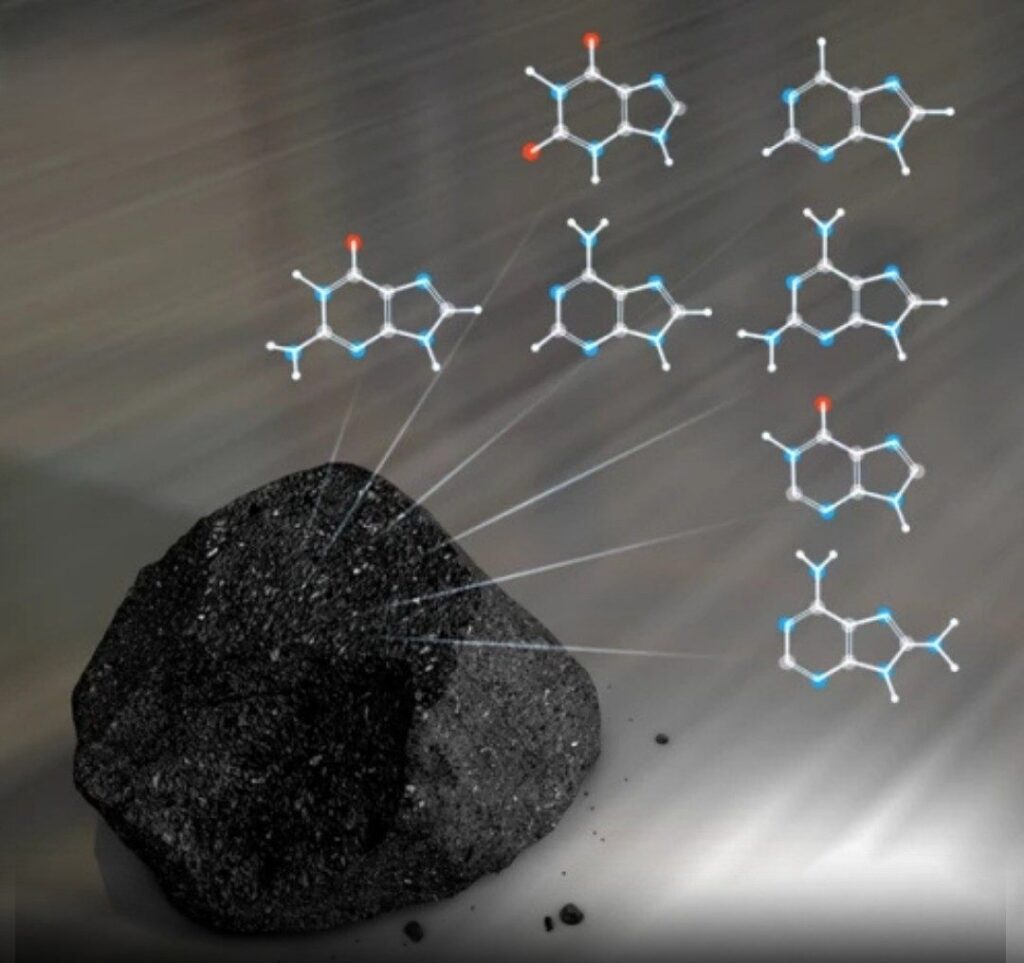
Under panspermia, planets like Earth may have been seeded with life’s fundamental ingredients delivered through meteorites during the early solar system’s bombardment period. Traces of amino acids, nucleobases, and organic molecules have already been found in several meteorites such as Murchison and Tagish Lake. However, detecting something so close to human DNA in ancient extraterrestrial material would elevate the concept from speculative to paradigm-shifting.
If verified, humanity’s origins may not be solely terrestrial; our biological code may represent a universal pattern—a shared molecular language across space.

Methods and Contamination Controls
Because the implications are vast, the researchers employed an unprecedented contamination control regime. Sample extraction occurred in sterile clean chambers within vacuum-sealed environments. DNA sequencing was repeated with multiple blind controls and verified using independent labs on different continents.
Key measures included:
-
Using ultra-pure reagents and non-human DNA markers to detect false positives.
-
Performing isotope ratio mass spectrometry to distinguish terrestrial nitrogen and carbon signatures from extraterrestrial ones.
-
Cross-referencing sequencing data with global genomic databases to exclude human handling contamination.
Despite these precautions, many experts remain skeptical. Even trace contamination from lab environments or field handling could produce misleading results. Thus, confirmation by independent teams will be essential before rewriting textbooks.
Cosmic DNA and the Architecture of Life
If the discovery holds true, it suggests that DNA—or a primordial version of it—might be a universal molecular architecture for life. Perhaps evolution did not begin on Earth, but merely continued here.
Emerging astrophysical research already supports this possibility. Complex organic molecules such as glycine, adenine, and ribose have been detected in interstellar clouds and icy comets. These molecules are the building blocks of life’s genetic code. The discovery of DNA-like fragments in ancient meteorites would therefore represent the missing piece of a long cosmic puzzle.
For biochemists, this could indicate that DNA’s structure is not an accident of Earthly chemistry but rather a convergent solution favored by the physical laws of the universe.
Implications for Human Origins
This discovery could profoundly affect how we define humanity’s place in the cosmos. If genetic material akin to ours existed elsewhere far before life evolved on Earth, it may suggest that evolution is not confined to one planet’s timeline.
Three key implications emerge:
-
Shared Molecular Heritage: Our genetic structure may have interstellar roots, connecting humanity to a universal biological continuum.
-
Redefinition of “Alien”: Life elsewhere may not be entirely foreign—it might carry genetic architectures similar to humans.
-
Chronology of Evolution: Molecular life may predate Earth itself, implying a far older and broader biological history.
Such implications blur the boundary between biology, astronomy, and philosophy—suggesting that consciousness itself may be an expression of the universe striving to understand its own origins.
Scientific Community Reactions
Since the research was first announced, reactions from the global scientific community have ranged from cautious curiosity to outright skepticism. Many experts emphasize the need for extreme caution, noting similar claims in the past have collapsed under scrutiny—either through contamination or misinterpretation of data.
Astrobiologists point out that extraordinary claims require extraordinary evidence. Genomic similarities alone cannot confirm extraterrestrial origin. Researchers will need to demonstrate isotopic anomalies, radiation damage patterns, and mineral-embedded biomolecules consistent with long-term space exposure.
Still, the idea that DNA-like molecules could form naturally under cosmic conditions is not implausible. Simulations of early solar nebula chemistry suggest that ultraviolet radiation and cosmic dust interactions can synthesize nucleobase analogs. The discovery thus provides a tantalizing glimpse of how cosmic chemistry may transition into biology.
The Historical Context of Life’s Cosmic Theories

The concept that life might originate beyond Earth is not new. In ancient Greece, philosophers such as Anaxagoras proposed that life was “sown” throughout the universe. During the 19th century, scientists like Svante Arrhenius formalized panspermia, suggesting spores could travel between planets by radiation pressure.
Modern supporters of panspermia, including Fred Hoyle and Chandra Wickramasinghe, argued that life continuously arrives from space—a hypothesis that once attracted ridicule but has steadily gained empirical support as organic compounds have been found on comets and asteroids.
The new evidence of human-like DNA fragments reignites this age-old debate, potentially bridging ancient philosophical speculation and modern molecular science.
Possible Explanations Beyond Panspermia
While panspermia offers a compelling explanation, several alternative scenarios could account for the observed DNA fragments:
-
Contamination Artifact: Despite contamination controls, microscopic handling errors may have introduced trace human DNA.
-
Terrestrial Microbial Mimicry: Ancient Earth microbes with DNA-like sequences might have contaminated the meteorite after its fall.
-
Laboratory Artifact: Data noise or sequencing cross-talk in genomic analysis software can produce false similarities.
-
Convergent Molecular Evolution: Molecular chemistry may naturally produce repeating nucleotide patterns similar to human DNA without any direct ancestral link.
Each scenario requires systematic elimination through experiments, replication, and isotope-level verification before drawing conclusions.
Philosophical and Cultural Dimensions
Beyond its scientific implications, the discovery resonates with one of humanity’s timeless questions: Where do we come from? For centuries, myths, religions, and philosophies across cultures have speculated that humans are connected to the heavens. From the Egyptian “seed of Ra” to the Sumerian myths of celestial creation, our ancestral stories often link humanity’s birth to the stars.
A scientific discovery that traces human genetic precursors to interstellar origins could merge myth and science in unexpected harmony. It could affirm that our quest for meaning and origin has always been, in some sense, cosmic.

The Future of Research: From Controversy to Consensus
To move forward, scientists have outlined several key steps:
-
Independent Replication: Separate laboratories must reproduce the results using untouched portions of the meteorite.
-
Deep Isotopic Profiling: Researchers must confirm extraterrestrial isotope ratios distinct from any Earth-based contamination.
-
Comparative Genomics: Cross-referencing the sequences found in the meteorite with all known Earth genomes can reveal whether they’re genuinely unique.
-
Space Sample Validation: DNA testing of unexposed extraterrestrial samples (e.g., from asteroids and Mars missions) could provide crucial confirmation.
Upcoming missions such as NASA’s OSIRIS-REx and JAXA’s MMX (Martian Moons eXploration) will return pristine samples that may shed light on the universality of life’s molecules.
The Broader Impact on Evolutionary Biology
If DNA traces in meteorites are validated as genuine and extraterrestrial, evolutionary biology would undergo a profound shift. Life’s tree of evolution may not have its roots in the primordial oceans of Earth but in a galactic biological network stretching across time and space.
This could redefine Darwin’s framework into a broader concept—Cosmic Evolution—where natural selection operates across planetary systems, with interplanetary interchanges of biological material forming a shared evolutionary continuum.
Such a paradigm would not diminish Darwinian evolution but extend it into a universal framework where life is a galactic phenomenon, evolving wherever conditions permit.
The Universe as a Living System
If biology’s foundation is cosmic, then perhaps the universe itself is not a lifeless void but a dynamic, self-replicating system. Some physicists and astrobiologists propose that cosmic structures—galaxies, stars, planets—act as “nurseries” for life. In this sense, life is intrinsic to the universe’s design.
DNA, as a universal molecule of organization, could serve as the universe’s own method of self-expression—a code repeated across worlds, evolving toward complexity and consciousness.
The discovery of human-like DNA in a billion-year-old meteorite would be a whisper from the stars, suggesting that our story might be older and grander than Earth itself.

Conclusion: Our Shared Cosmic Heritage
Even as debates continue, this extraordinary finding has reignited humanity’s fascination with its origins. Whether the DNA fragments prove genuinely extraterrestrial or represent an extraordinary case of convergent chemistry, the discovery underscores an essential truth: life is deeply connected to the cosmos.
If verified, humanity may trace its lineage not simply to ancient oceans but to the very fabric of the universe—atoms forged in stars, molecules shaped in interstellar clouds, and genetic codes written before Earth was born.
The concept of cosmic ancestry invites a profound reflection: we are not merely inhabitants of the universe; we are participants in its unfolding biological story—a chapter still being written in the language of the stars.