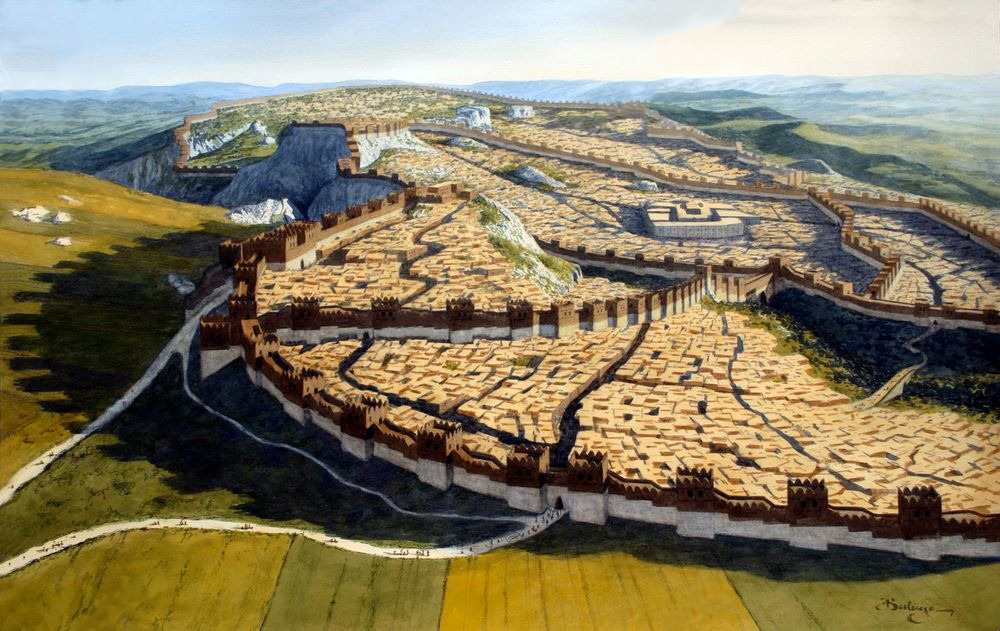
Rising dramatically from the rugged hills of north-central Türkiye, the archaeological site of Hattusa stands as a testament to the grandeur of the Hittite Empire, one of the ancient world’s most powerful civilizations. Located in modern-day Boğazkale in Çorum Province, Hattusa flourished as the capital of the Hittite Empire from around 1650 BCE through the 13th century BCE. It was a city of monumental proportions, remarkable for its sophisticated urban planning, massive defensive walls, grand temples, and royal palaces that reflected the might and religious devotion of the Hittite kings.
Once a vibrant city that rivalled the great powers of Egypt and Babylon, Hattusa was abandoned sometime around 1200 BCE following the collapse of the Hittite Empire. Today, it is a UNESCO World Heritage Site, acclaimed for its archaeological significance and striking preservation of Bronze Age architecture and artifacts.
1. Historical Background of Hattusa and the Hittite Empire
The Rise of the Hittite Empire
The Hittite Empire emerged around the 18th century BCE in Anatolia (modern Turkey). Its people spoke an Indo-European language and developed a powerful kingdom known for military prowess, diplomacy and legal innovations. Hattusa, strategically located in a fertile valley surrounded by natural defenses, became the empire’s capital under King Hattusili I around 1650 BCE.
From this base the empire expanded rapidly, encompassing vast territories across Anatolia, northern Syria and parts of Upper Mesopotamia. Under kings like Suppiluliuma I in the 14th century BCE, the Hittites maintained power through military strength (including iron weaponry and chariots) and forged diplomatic ties and treaties with the neighbouring states.
The Glory Days: Politics, Warfare and Diplomacy
The Hittites created what is often termed the earliest known peace treaty in world history following the epic Battle of Kadesh against Egypt under Ramesses II around 1274 BCE. Their empire thrived as a complex polity balancing warfare, administration and religion.
The Mysterious Decline and Fall

Around 1200 BCE, the Hittite Empire collapsed, likely due to a combination of factors including invasions by the Sea Peoples, internal political strife, economic decline and environmental stresses such as famine or drought. Hattusa was abandoned, and while parts were later occupied by Assyrians and Phrygians, the city never regained its former status.
2. Architectural Marvels of Hattusa: City Walls, Gates and Temples
The City Walls and Fortifications
Hattusa’s city walls stretched for over six kilometres, forming a formidable defence system of multiple layers of thick fortifications set on rocky ridges and cliffs.
Among the most famous gateways are:
-
Lion Gate: Famous for two majestic lion statues that guarded the entrance, symbolizing strength and protection. Kultur Portali+1
-
King’s Gate: A heavily-ornamented gate adorned with relief of a warrior or possibly the king, highlighting the artistic and symbolic importance of royal power.
-
Sphinx Gate: Decorated with sphinx statues and located on a high artificial mound, the gate exuded an aura of mysticism and grandeur.
These gates were part of a sophisticated defensive design that included secret tunnels like the 70-metre “Yerkapı” tunnel under the Sphinx Gate, allowing protected movement within the city walls.
The Great Temple: Religion at the Heart of Hattusa
At the city’s centre stood the Great Temple—a massive complex dedicated to the storm god Teshub and the sun goddess Arinna (or Hebat). It was the largest and most spiritually significant temple, and served as a hub of political and religious activities.
Key features of the temple include:
-
enormous courtyards for public religious ceremonies
-
inner sanctuaries housing cult statues accessible only to priests and the royal family
-
storerooms for offerings and ceremonial goods
Royal Palaces and Administrative Centres
The Royal Palace, located on the high ridge known as Büyükkale (Great Fortress), served as the king’s residence and the administrative heart of the empire. It included living quarters, a throne room where the king conducted political affairs, and archives preserving thousands of clay tablets detailing legal, diplomatic and economic activities.

The Cuneiform Tablets: Keys to the Hittite World
Excavations at Hattusa have unveiled approximately 30,000 clay tablets inscribed in cuneiform script. These artifacts included treaties, myths, laws and administrative records—offering unparalleled insights into Hittite life.
The tablets preserved:
-
diplomatic treaties (including the world’s earliest known peace treaty)
-
religious texts and rituals central to Hittite spiritualism
-
mythological narratives revealing the Hittite worldview
-
administrative documents detailing the workings of the empire
The Yazılıkaya Sanctuary: An Open-Air Rock Temple
Situated just outside Hattusa lies the rock sanctuary known as Yazılıkaya. It is carved into natural chambers in the mountainside and adorned with rock-reliefs depicting the pantheon of Hittite gods and goddesses, as well as representations of King Tudhaliya IV.
Yazılıkaya highlights the religious artistry of the Hittites and serves as a testament to their deep spiritual beliefs—connecting the divine with kingship in stone.
3. Daily Life in Hattusa: Residential and Urban Organization
Archaeology reveals that Hattusa was divided into upper and lower city districts. The lower city housed the majority of the population, featuring:
-
residential homes demonstrating Hittite architectural styles
-
workshops for artisans crafting pottery, textiles and metal-work
-
public buildings such as granaries and administrative offices reflecting well-organised urban planning.
The upper city contained mainly temples, sanctuaries and royal complexes, emphasising the division between political-religious elites and commoners.

The site’s layout and remains of urban machinery (walls, gates, storage facilities) show that the Hittites achieved an advanced level of city-planning relative to many of their contemporaries.
4. Rediscovery and Archaeological Excavations
The site of Hattusa was first brought to wider attention in 1834 by French scholar Charles Texier. Systematic excavations, mainly by the German Archaeological Institute, began in 1906 and continue to modern times.
Significant discoveries include:
-
intact temple foundations
-
royal residences and fortifications
-
rock-art and monumental gates
-
previously unknown linguistic documents that expanded understanding of Indo-European languages.
These excavations have helped rebuild one of antiquity’s lesser-known but extremely sophisticated civilizations.
5. Hattusa Today: A UNESCO World Heritage Site
Since 1986, Hattusa has been protected as a UNESCO World Heritage Site for its outstanding universal value representing:
-
unique urban organisation and architectural styles of the Bronze Age
-
the artistic and cultural achievements reflected in monumental gates and rock-art
-
the political, religious and economic life of a major ancient empire
-
the exceptional preservation of temples, palaces, city walls and archives

As UNESCO writes: “The archaeological site of Hattusha … is remarkable for its urban organization, the types of construction that have been preserved (temples, royal residences, fortifications), the rich ornamentation of the Lions’ Gate and the Royal Gate, and the ensemble of rock art at Yazılıkaya.”
Today Hattusa welcomes travellers, historians and archaeologists eager to explore its ruins and immerse themselves in the ancient world.
6. Visiting Hattusa: Practical Information and Tips
How to Get There
Hattusa is located near the village of Boğazkale in Çorum Province, approximately 150 km east of Ankara, Turkey. Visitors can reach the site by car, bus or as part of guided tours from Ankara or other regional centres.
Best Time to Visit
Ideal months are spring (April-June) and autumn (September-October) due to mild weather. Summers can be very hot, and winters cold with occasional snow.
Facilities and Visitor Tips
-
There is a visitor centre providing historical information and maps.
-
Guided tours are available, which help contextualise the vast site.
-
Wear comfortable walking shoes — the terrain is rugged and extensive.
-
Bring water and snacks; facilities inside the site are limited.
-
Respect the ancient structures; avoid climbing or touching fragile remains.

7. The Legacy of Hattusa: Bridging Past and Present
Hattusa remains one of the most important archaeological sites for understanding the Bronze Age Anatolian world. Its ruins tell stories of imperial majesty, religious fervour, and advanced urban planning. The legacy of the Hittite Empire, preserved in Hattusa, continues to inspire scholars, historians and visitors fascinated by one of humanity’s earliest great civilizations.
By exploring Hattusa, we connect with a powerful empire that played a pivotal role in Near Eastern history and left behind a heritage echoing through millennia.
ALSO READ: The Woman Who Wore the Silk Road: A Fashion Discovery Buried for 2,000 Years