A Tangible Link to Eternity: Unveiling the Relic of a Church Father
In the city of Pavia, Italy, rests a spiritual and historical treasure of immense significance: the relic known as the Hand of Saint Augustine. Ensconced within the Basilica di San Pietro in Ciel d’Oro (or Sant’Agostino Maggiore), this relic is not merely an object of medieval veneration; it is a profound, tangible connection to one of the most influential figures in Christian history, Saint Augustine of Hippo (354–430 AD).
The presence of this relic transforms the basilica into a focal point for pilgrims, historians, and art enthusiasts alike. It represents a powerful intersection of faith, history, and the enduring human desire for physical proximity to the sacred.
The Life and Legacy of Saint Augustine
To truly appreciate the relic, one must first consider the man it represents. Augustine of Hippo was a towering intellect, a prolific writer, and a theologian whose works—such as Confessions and The City of God—continue to shape Western philosophy and Christian doctrine millennia later. He lived through the tumultuous late Roman Empire, serving as the Bishop of Hippo Regius (in modern-day Algeria) until his death in 430 AD.
The hand, once raised in powerful oration and used to pen the foundational texts of Western thought, is a symbol of this monumental legacy. Its silence in the reliquary is a striking counterpoint to the powerful, resonant voice that continues to speak through his writings.
The Journey of the Relics to Pavia, Italy
The journey of Saint Augustine’s remains to Pavia is a fascinating tale of survival, translation, and devotion spanning centuries.
Originally interred in Hippo, the saint’s body was moved several times over the centuries to protect it from invasions and instability:
-
5th Century: Moved from Hippo to Sardinia by Catholic bishops fleeing Vandal persecution.
-
8th Century: In the early 700s, the remains were acquired by King Liutprand of the Lombards and transported to his capital, Pavia, where they were eventually placed in the church of San Pietro in Ciel d’Oro.
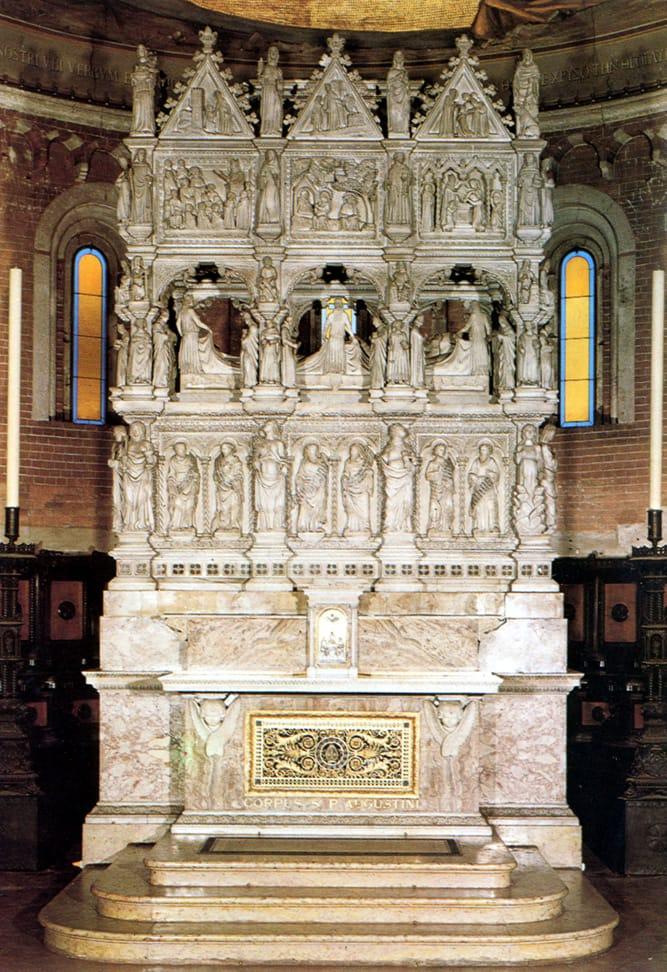
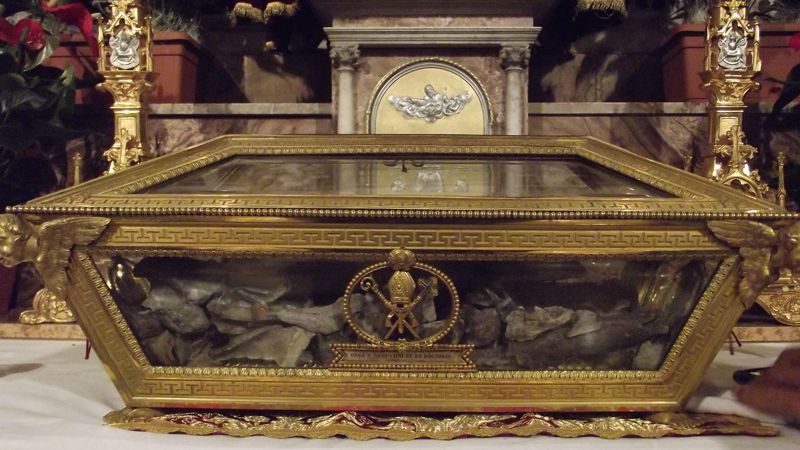
While the majority of the saint’s bones are contained within the magnificent marble Arca di Sant’Agostino in the same basilica. The isolated Hand of Saint Augustine is often preserved in a separate, specially crafted reliquary. This practice of separating smaller fragments (a common occurrence with major relics) highlights the immense value placed on every part of the saint’s physical form.
The Appearance and Presentation of the Sacred Hand
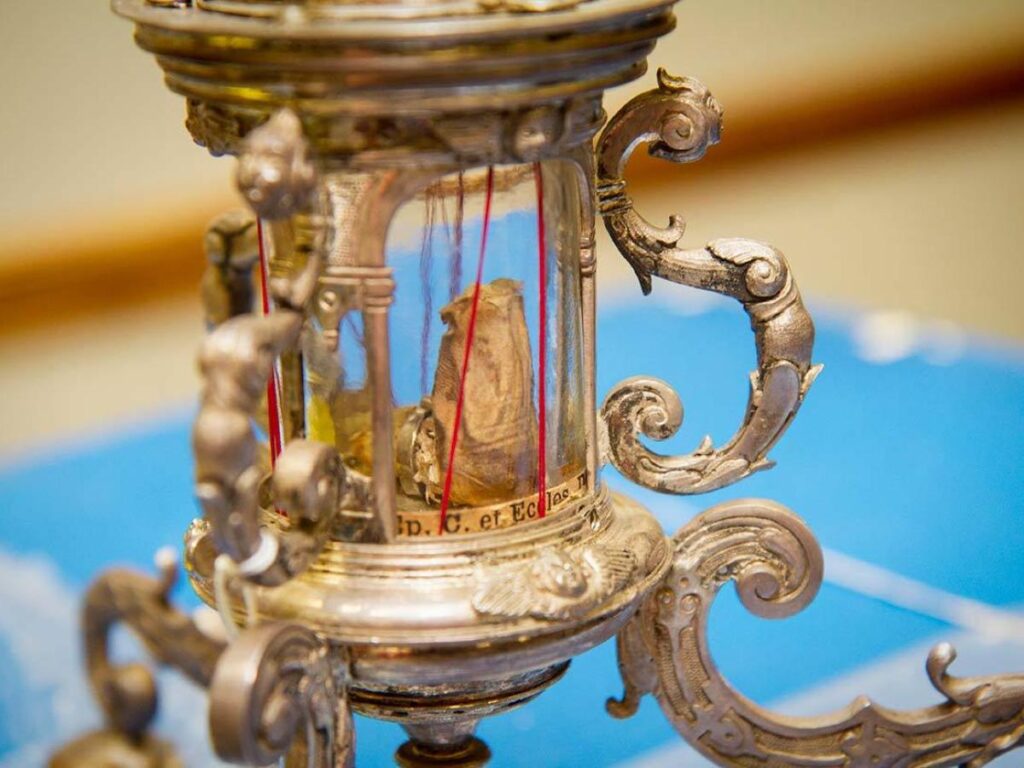
The reliquary itself is a masterpiece of devotional art, typically gilded, jeweled, and designed to inspire awe and reverence. The relic inside—the Hand of Saint Augustine Pavia is known for its:
-
Darkened, Petrified Appearance: Centuries of preservation, contact with burial environment, and perhaps the use of historical embalming or preservation methods have left the relic with a deep, almost petrified hue. This look is a visual testament to its extreme antiquity, connecting it directly to the 4th and 5th centuries.
-
Imposing Presence: Despite being a fragment, the hand commands attention. The elaborate reliquary frames it, magnifying its spiritual power and making it a clear focus for devotion.
The contrast between the reliquary’s priceless metals and craftsmanship and the ancient, simple corporeal fragment within underscores a core tenet of faith: the mortal houses the eternal.
The Profound Significance of Veneration
For the faithful, the Hand of Saint Augustine is more than a historical artifact; it is a touchstone for faith. Relics serve as potent intermediaries, bridging the gap between the worshipper and the revered saint.
The veneration of this relic in Pavia serves several key functions:
-
Historical Connection: It offers a concrete, physical link to a giant of the past, allowing pilgrims to feel they are standing in the presence of someone who walked the earth 1,600 years ago.
-
Spiritual Focus: It is a focus for prayer, meditation, and asking for the saint’s intercession, reminding believers of the “communion of saints.”
-
Cultural Heritage: For Pavia, the possession of such a significant relic elevates the city’s historical and religious stature, drawing scholars and visitors interested in early Christian and medieval history.
The paradox inherent in this relic is striking. A fragment of mortality, a withered hand, yet it points toward the promise of eternity. It is a symbol of mortality’s dance with eternity, an arresting, timeless piece of the past preserved for the present.
Conclusion: Silent Testimony in Pavia
The Hand of Saint Augustine, resting in silent testimony in the heart of Pavia, endures as a powerful symbol. It reminds us of the profound impact of a single life, the long, winding journey of history, and the enduring nature of human belief. Whether viewed through the lens of faith, history, or art, the relic encapsulates a vital chapter of Western civilization. Forever linking the ancient world of Hippo to the modern spiritual landscape of Italy.
Ready for the Next Step?
Would you like me to find information about visiting the Basilica di San Pietro in Ciel d’Oro in Pavia. Including its opening hours or other notable features?
That’s a great next step! The Basilica di San Pietro in Ciel d’Oro is a treasure trove of art and history, and having the practical information is key for a visit.
Here are the details for visiting the Basilica of San Pietro in Ciel d’Oro in Pavia. Which houses the relics of Saint Augustine:
⛪ Basilica di San Pietro in Ciel d’Oro: Visitor Information
The basilica is an active place of worship and a major historical site. Known for its Romanesque architecture and its two most significant relics. The remains of Saint Augustine and the tomb of the 6th-century philosopher Boethius.
1. Location and Address
-
Basilica Name (Italian): Basilica di San Pietro in Ciel d’Oro (often referred to as Sant’Agostino Maggiore)
-
Address: Piazza San Pietro in Ciel d’Oro 2 – 27100 Pavia, Italy
2. General Opening Hours
The opening hours of the Basilica are generally quite consistent throughout the year. But it’s always advisable to check a local source before a specific trip. As times can change for special religious holidays or events.
| Time Slot | Daily Hours |
| Morning | 8:30 AM – 12:00 PM |
| Afternoon/Evening | 3:00 PM – 7:00 PM |
-
Note: The Basilica is generally open every day, and admission is typically free.
3. The Arca di Sant’Agostino (The Main Shrine)
While the Hand of Saint Augustine is often kept in a separate reliquary. The main focus for the saint’s remains is the spectacular Arca di Sant’Agostino (Ark of Saint Augustine).
-
What it is: A monumental marble shrine, or funerary monument, that dates to the second half of the 14th century (circa 1362). It is considered a masterpiece of the Campionesi masters (or Giovanni di Balduccio).
-
Key Features: It is highly intricate, composed of multiple levels with over 95 statues and 50 elaborate bas-reliefs depicting scenes from the life of Saint Augustine and miracles attributed to him, as well as the translation of his body to Pavia.
-
Location: The Basilica places the Arca prominently on the high altar, and it contains the ancient silver casket that holds most of the saint’s bones.
4. Other Notable Features
Beyond the relics, the Basilica itself is a stunning example of Lombard Romanesque architecture and is notable for:
-
The Name: “Ciel d’Oro” translates to “Golden Sky,” referring to the original mosaics of gold leaf and glass tesserae that decorated the apse ceiling.
-
The Tomb of Boethius: The philosopher Anicius Manlius Severinus Boethius (c. 480–524), author of The Consolation of Philosophy, is also interred within the Basilica.
-
Historical Significance: The Basilica was an important center for the Augustinian order for centuries and played a vital role in the history of Pavia as the capital of the Lombard kingdom.
ALSO READ: The Bronze Snake Statues of Urculs: Ancient Relics from Sacred Springs