Before the Dinosaurs Ruled
Long before dinosaurs thundered across the continents, Earth was home to creatures whose appearance defies expectations. Among these early land rulers was Cotylorhynchus bransoni, a member of the caseid synapsids that thrived roughly 280 million years ago during the Early Permian period. Though nearly forgotten compared to the later reptiles and dinosaurs, Cotylorhynchus represents a crucial chapter in evolutionary history—the rise of mammal-like life on land.
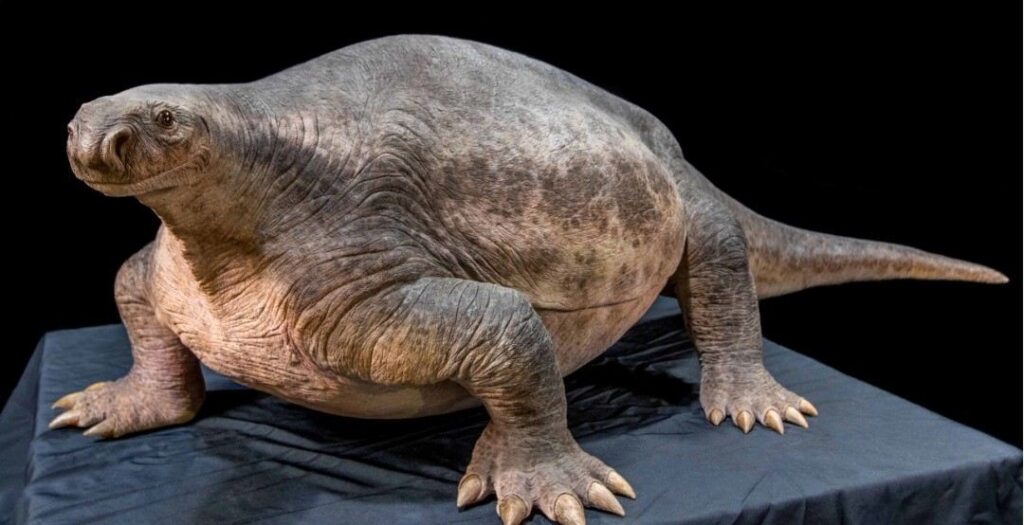
At a staggering six meters long and weighing close to two tons, Cotylorhynchus was one of the largest land-dwelling vertebrates of its time. Its small head, stubby legs, and enormous barrel-shaped body made it an icon of ancient oddities—a gentle vegetarian giant built for endurance and digestion rather than speed or predation.
The Permian World: An Age of Transition
Shifting Continents and Climate
During the Early Permian period, the Earth’s landmasses were merging into a single supercontinent known as Pangaea. Vast interior deserts stretched across continental interiors, while lush lowlands near rivers and floodplains supported early forests of seed ferns, horsetails, and primitive conifers. The atmosphere fluctuated between humid and arid cycles, forcing adaptations in both plants and animals.
Cotylorhynchus thrived in these fertile seasonal landscapes where vegetation was abundant but often fibrous and nutritionally poor. The species’ anatomy reflects the biological responses to these environmental challenges.

The Rise of Synapsids
Before reptiles truly took center stage, it was the synapsids—creatures more closely related to mammals—that dominated terrestrial ecosystems. Synapsids possessed a single temporal opening behind their eye sockets, a structural trait that allowed for stronger jaw muscles. Over millions of years, this lineage gave rise to diverse forms such as the predatory Dimetrodon and the plant-eating Cotylorhynchus.
These early synapsids are sometimes nicknamed “mammal-like reptiles,” though that term is misleading. They were not reptiles at all but evolutionary precursors to mammals, marking the first great wave of land vertebrate dominance.
Anatomy of Cotylorhynchus: A Study in Evolutionary Design
A Body Built for Bulk
The most striking aspect of Cotylorhynchus bransoni’s anatomy is its body proportion. With an immense, round torso that dwarfed its limbs and head, it looked almost comical. Yet each feature had evolutionary logic. Its immense gut cavity likely contained a long digestive tract, necessary for fermenting and breaking down cellulose-rich plants.
Much like modern herbivores such as elephants or cows, Cotylorhynchus may have hosted symbiotic gut microbes to help digest fibrous vegetation. Its slow metabolism, combined with possible fat reserves within its body, enabled it to endure harsh dry seasons.
The Tiny Head Mystery
Paleontologists have long puzzled over its disproportionately small head, which appears almost inadequate for such a body. However, this feature suggests dietary specialization. Cotylorhynchus likely fed constantly on soft plant material, swallowing it in large quantities with minimal chewing. Its jaw muscles were modest, but its long, spatulate teeth were well-suited for cropping vegetation close to the ground.
Limbs for Endurance, Not Speed
Its limbs were short and sturdy, indicating that Cotylorhynchus moved slowly, perhaps with a sprawling gait. The heavy barrel body would have required strong limb bones and robust musculature to support its mass. Evidence suggests it roamed shallow wetlands or open floodplains rather than steep terrain.
The overall design emphasizes energy conservation over mobility. Its environment provided safety through size—a slow creature few predators dared to challenge.
Lifestyle and Behavior: The Gentle Giant of the Permian
A Diet of Fibrous Greenery
Cotylorhynchus was among the earliest large terrestrial herbivores. Its diet included low-lying ferns, seed plants, and early cycads. These plants were nutrient-poor, requiring bulk consumption and slow digestion. Over evolutionary time, this need likely drove its expansion in body size—a phenomenon known as herbivorous gigantism.
By growing large, Cotylorhynchus could maintain a gut large enough to process its food efficiently, balancing out the low energy yield from its diet.
Habitat Preferences

Fossil evidence suggests Cotylorhynchus lived near ancient floodplains and river valleys in what is now North America, particularly Texas and Oklahoma. These regions offered a mix of plant life and moisture sources in otherwise seasonal climates.
Its large size and tolerance for hot, semi-arid conditions hint at physiological adaptations perhaps comparable to modern-day large mammals, which use bulk and low surface area-to-volume ratios to retain moisture.
Movement and Social Behavior
Though direct fossil evidence for herding or sociality is scarce, analogies with later herbivores suggest that Cotylorhynchus may have lived in loose groups. Such behavior would provide defense against early predators like Dimetrodon, another Permian synapsid.
Slow, deliberate movement likely characterized its daily rhythm—feeding through the cool hours and resting during the hotter parts of the day.
Evolutionary Importance: Early Experiments in Size
The Path to Mammalian Traits
As a caseid synapsid, Cotylorhynchus belongs to a lineage that already displayed several traits inherited by later mammals: differentiated body temperature regulation, complex metabolism, and advanced jaw musculature. While not warm-blooded in the mammalian sense, caseids hint at the physiological direction evolution was heading.
Cotylorhynchus illustrates the evolutionary experimentation that occurred long before mammals truly emerged. It achieved ecological success through gigantism rather than predation—a model later mirrored by herbivorous dinosaurs.
The Evolutionary Paradox of Gigantism
Why did such an ungainly creature grow so large? The answer lies in ecological balance. In a world dominated by carnivorous synapsids, bulk offered both protection and metabolic efficiency. A larger body conserves energy and helps maintain stable internal temperatures, crucial in fluctuating climates.
Cotylorhynchus shows that in evolution, size itself can be a form of adaptation—allowing organisms to exploit new ecological niches even in challenging conditions.
Fossil Discoveries and Scientific Research
Unearthing the Giants
Cotylorhynchus fossils were first described in the early 20th century from deposits in Texas and Oklahoma. These regions preserve rich Permian red beds, ancient sedimentary layers that capture the life of the era in extraordinary detail.
The most complete skeletons show the species’ iconic shape: a domed torso, a long tail, and an almost comically small skull. These fossils reveal how diversified synapsids were during the Permian long before dinosaurs took over the mantle of terrestrial dominance.

Advances in Paleobiology
Modern imaging and computational models have allowed scientists to test old assumptions about Cotylorhynchus anatomy. 3D reconstructions and biomechanical simulations suggest it was capable of terrestrial locomotion more efficient than once believed, possibly combining walking with slight tail support—a semi-sprawling gait.
Stable isotope analysis from fossilized bones has provided hints about its diet and environment, reinforcing the concept of a slow-metabolizing, plant-eating giant.
The Environment It Ruled: Permian Ecosystems Revisited
The Early Permian Climate
The Permian period marked a climatic shift from humid Carboniferous swamps to more arid conditions. Global temperatures rose, and many species adapted to survive in alternating wet-dry cycles. This climate pushed evolutionary innovation in both plants and animals.
Cotylorhynchus coexisted with an array of other species—predatory synapsids such as Dimetrodon and Sphenacodon, as well as smaller plant-eaters like Edaphosaurus. This mix made Permian floodplains vibrant, competitive ecosystems.
Plant Evolution in the Permian
Plant life had begun to evolve beyond simple ferns toward seed-bearing species, better adapted to dry conditions. Cotylorhynchus’s preference for fibrous vegetation shows how mammalian ancestors participated in the gradual shift toward fully terrestrial ecosystems.
Its grazing influenced plant communities much like large mammals shape environments today, possibly contributing to the spread of certain resilient Permian flora.
Comparing Cotylorhynchus to Other Prehistoric Giants
| Feature | Cotylorhynchus bransoni | Dimetrodon | Edaphosaurus |
|---|---|---|---|
| Period | Early Permian | Early Permian | Early Permian |
| Diet | Herbivorous | Carnivorous | Herbivorous |
| Size | Up to 6 meters | Up to 4 meters | About 3.5 meters |
| Skull | Small and blunt | Large with sail | Flat with sail |
| Limb Posture | Sprawling | Semi-erect | Sprawling |
| Significance | Early large herbivore, mammal ancestor | Apex predator | Plant-eating counterpart to Dimetrodon |
This comparison reveals Cotylorhynchus as the ecological balance to Dimetrodon’s predation—a herbivore whose massive presence shaped the food web long before similar dynamics appeared in dinosaur ecosystems.

The Decline of Cotylorhynchus and Its Kin
Changing Climates, Changing Faces
As the Permian progressed, global climates became even drier. Wetland-dependent species like Cotylorhynchus faced shrinking habitats. Over time, caseid synapsids dwindled, replaced by other forms better suited to aridity, such as the therapsids—true precursors of mammals.
The end of the Permian brought the greatest extinction event in Earth’s history, wiping out over 90% of marine species and a vast number of terrestrial vertebrates. Cotylorhynchus and its relatives vanished, leaving an evolutionary gap soon filled by new types of synapsids.
Legacy in the Tree of Life
Although extinct, Cotylorhynchus’s place in the evolutionary lineage is vital. It stands as one of the earliest examples of efficient plant-eating vertebrates. By experimenting with size, metabolism, and slow lifestyle strategies, creatures like Cotylorhynchus paved the way for later herbivores that would inherit Earth’s terrestrial ecosystems.
Artistic Reconstructions: From Fossil to Life
Modern paleoart has reimagined Cotylorhynchus as more than a prehistoric oddity. Renowned illustrators like Sergey Krasovskiy depict it as a vibrant, lifelike herbivore moving through lush Permian floodplains—giving a face to an era often overshadowed by dinosaurs.
These reconstructions emphasize not ridicule but respect, portraying Cotylorhynchus as a creature that thrived through evolutionary ingenuity. Each image brings new appreciation for life’s experimentation and the diversity preceding the familiar forms of today.
Lessons from Cotylorhynchus: Evolution’s Creative Path
The story of Cotylorhynchus bransoni offers profound lessons about life’s adaptability. It demonstrates that evolution does not always favor speed or aggression but resilience and efficiency. In an age of uncertainty and shifting ecosystems, this gentle giant succeeded by turning challenges into opportunities.

Its journey from an obscure Permian floodplain to a symbol of early mammalian innovation underscores the unpredictable path of evolution. Size, slow metabolism, and adaptability became survival assets in an environment of extremes.
Even today, studying Cotylorhynchus enriches understanding of how life on Earth has balanced energy, structure, and survival across eons.
Conclusion: The Forgotten Architect of Land Ecology
Cotylorhynchus bransoni was not merely a prehistoric curiosity—it was a keystone in the early evolution of land animals. Through its immense size, unique anatomy, and dietary specialization, it pioneered ecological roles that would echo through tens of millions of years.
In its gentle slowness lay the blueprint for endurance, a legacy seen in today’s large herbivores. Long before dinosaurs reigned, Cotylorhynchus set the stage for mammalian evolution—showing that sometimes, being big, slow, and steady can indeed win the evolutionary race.
ALSO READ: The World’s First Civilization