A Dialogue Between Past and Present
Often when we look at ancient engineering, we imagine ruins frozen in time. But the Cornalvo Reservoir is different: built over two millennia ago, it still sustains life, water and nature. Its sinuous shape, guided by terrain, mirrors the sky and folds into surrounding oak-groves and hills. In its shimmering surface lies not just utility, but poetry—a reflection of what happens when human mind, stone and nature converse.
In what follows, this article explores the reservoir’s history, engineering, landscape, ecology, cultural significance, visitor experience, and the lessons it holds today.
Historical Foundation: The Roman Legacy
Origins and Purpose
The reservoir is formed by the dam known as the Cornalvo Dam (Spanish: Presa de Cornalvo) built across the Albarregas (Albar-regas) stream, northeast of the city of Mérida in the province of Badajoz, Extremadura.
The site was part of the Roman water‐supply system that supported the ancient city of Augusta Emerita (the Roman name for Mérida).
Date and Construction
While some sources date the dam’s core to the 1st century AD, more precise scholarly estimates point to the early 2nd century. For example, the Spanish‐language Wikipedia notes a date around AD 130 for the structure.
The dam was declared a national monument on 13 December 1912.
Structure & Roman Engineering Features
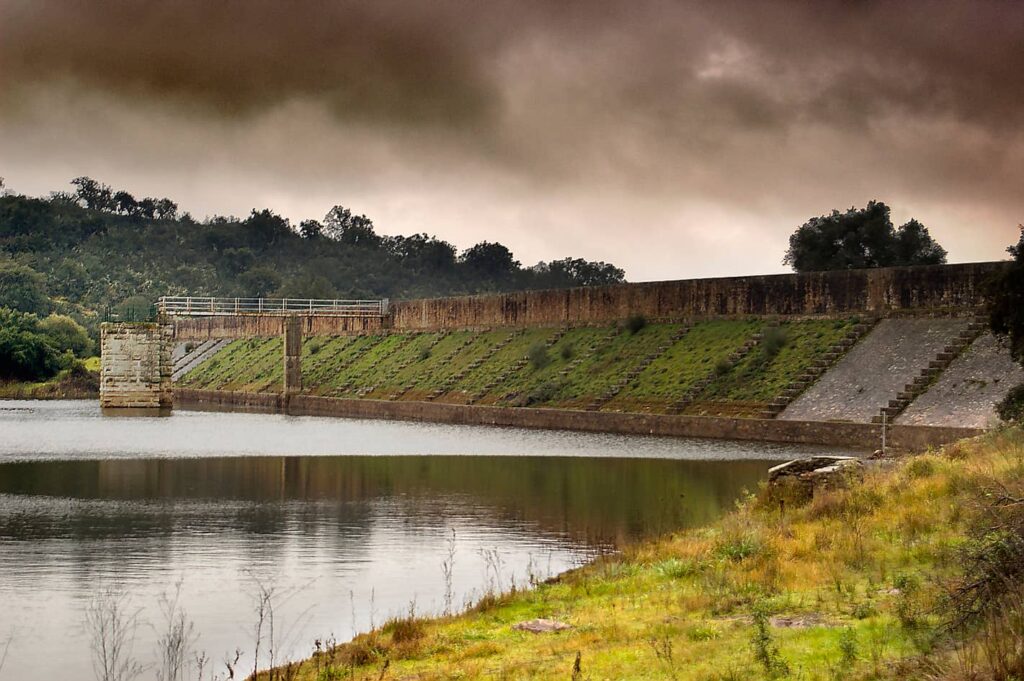
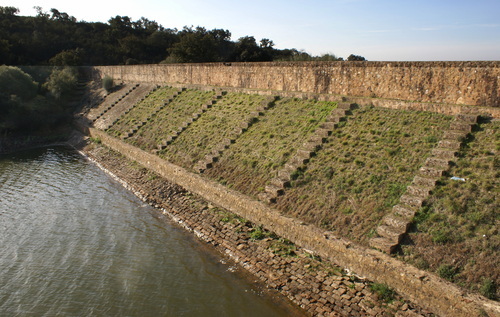
The dam is a gravity structure whose water‐face consisted of a sloping wall of dressed ashlars, backed by a core of concrete cells filled with compacted earth.
Length estimates vary: one French source gives 220 m length, height of about 18 m.
What is striking is that such an ancient structure was designed to supply a major Roman city, demonstrating advanced hydraulic thinking: capturing water from springs and streams, channeling it via aqueducts, and using reservoirs for storage and regulation.
The Landscape & Form: Nature’s Embrace of a Man-Made Lake
The Sinuous Shape
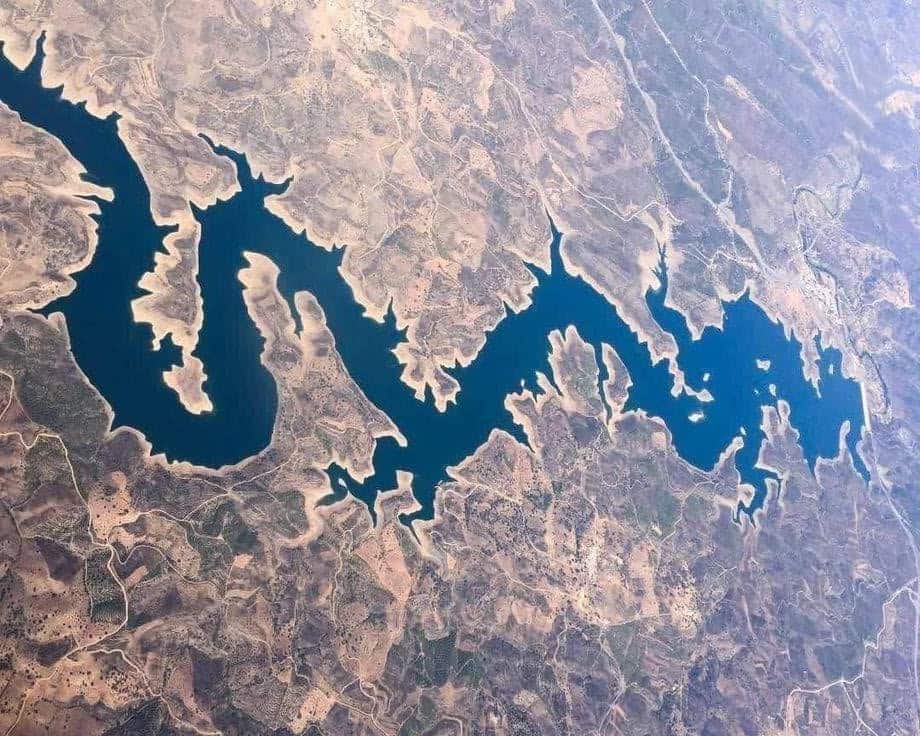
The reservoir’s shape is dictated by the terrain: nestled between low ridges (Sierra del Moro and Sierra Bermeja) the water fills the valley in a winding, horn-like formation.
This serpentine form means the edge of water and land merge and recede, creating a mosaic of reflections, peninsulas, shallow coves and oak groves.
The Vegetation & Surrounding Hills
The area around the reservoir falls within the Cornalvo Natural Park (Parque Natural de Cornalvo) — declared in 2004.
Here, holm oaks (quercus ilex), cork-oaks, Mediterranean woodland and dehesa pastures dominate. The gently rolling hills and ridges delineate the reservoir’s basin, creating a subtle amphitheatre of nature.
Reflections, Erosion and the Pass of Time
Over centuries, the water’s edge has been sculpted by erosion, weathering and seasonal variation. The sloping embankments, although man‐made, have begun to take on the character of natural slopes. The play of light across the water, the branch of an oak dipping into the reservoir, the quiet ripple of wind—all reinforce the sense that this is as much a wild site as an engineered one.
Ecology & Biodiversity: Life Flourishes Around Ancient Stone
Faunal Richness
Cornalvo Natural Park is home to more than 200 vertebrate species.
Notably, there are nesting pairs of black stork (Ciconia nigra) and other raptors, plus endemic fish like the jarabugo (Anaecypris hispanica) in the Aljucén river system.
The site has dual conservation status: classified as a Special Protection Area (ZEPA) and a Site of Community Importance (LIC) under the EU Natura 2000 network.
Aquatic and Terrestrial Interplay
The reservoir itself, while man‐made, functions ecologically: it moderates riparian flows, provides habitat for aquatic and amphibious creatures, and supports surrounding woodland communities. The water’s edge, shallowed by seasonal drawdown, becomes a fringe habitat for reeds, grasses and butterflies.
Conservation Challenges
While the site is protected, challenges remain: managing visitor access, controlling invasive species, balancing water-use with ecology, and mitigating climate stress (drought, changed rainfall patterns) on the reservoir and surrounding ecosystem.
Cultural & Archaeological Significance
A Living Monument
The reservoir is not simply a relic; it remains in use for water supply. The continuity of use from Roman times to the present day gives it an exceptional cultural dimension.
Connectivity to Mérida and Roman Heritage
The water collected here was part of the aqueduct system, like the Acueducto de Cornalvo, that supplied Augusta Emerita, one of the most important Roman cities on the Iberian Peninsula.
Today, the entire archaeological ensemble of Mérida is a UNESCO World Heritage Site. The reservoir and dam contribute to that legacy.
Aesthetic and Poetic Value
There are few places where one can walk beneath centuries-old Roman masonry, look across shimmering water, and listen to birdsong in a semi-wild oak wood. The juxtaposition of engineered stone, shimmering water, and wild nature creates a kind of contemplative space—a site of both memory and presence.
Visiting Cornalvo Reservoir: Practical Guide
Location and Access
The reservoir lies near the city of Mérida, in the province of Badajoz, Extremadura, Spain. According to Spain’s tourism site: “Inside the park you can find the Roman Cornalvo dam, declared a National Monument in 1912. It is a reservoir, shaped like a horn, about 4 kilometres long.”
From the Visitor Centre (Dehesa Boyal de Trujillanos) one can walk or drive into the park.
What to See & Do
-
Walk the shoreline paths: enjoy oak groves, water views, and wildlife.
-
Visit the Roman dam structure: appreciate the masonry and ancient architecture.
-
Bird-watching: early morning and dusk are ideal for raptors, storks and other species.
-
Photography: the water reflections, changing skies and sinuous shape provide compelling compositions.
-
Seasonal visits: autumn and spring bring particular beauty in foliage and light.
Visitor Tips & Considerations
-
Bring good walking shoes: terrain may be uneven, and paths may wind through oak woodland.
-
Respect conservation rules: the site is protected, so stick to marked paths, avoid disturbing wildlife.
-
Carry water, sun-protection: Extremadura can be hot in summer.
-
Check local information for guided tours, visitor centre opening hours.
-
Visit early morning for calm water and better wildlife spotting.
Best Time to Visit
While the reservoir is visitable year-round, spring (April–May) and autumn (September–October) offer comfortable weather, vibrant colours in the surrounding woodland, and good bird activity. Summer offers water and shade but also heat; winter may be quieter but cooler and moodier.
Engineering Insights & the Longevity of Stone
Roman Hydraulic Wisdom
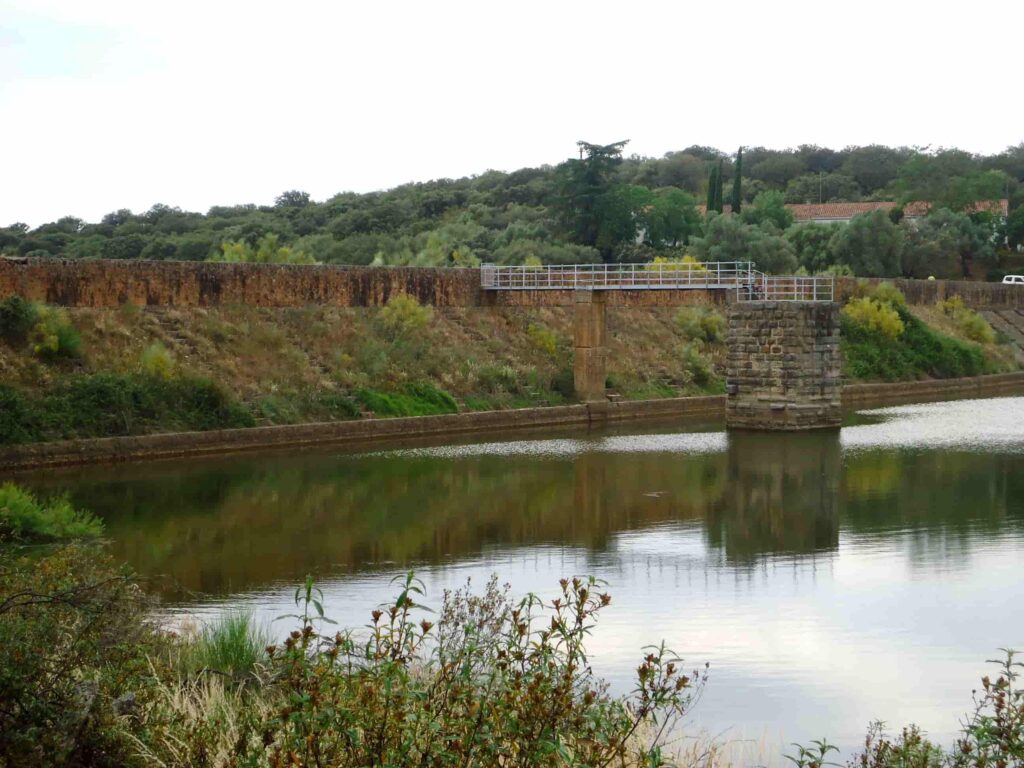
The dam’s design—a concrete cell core, earth fill, and dressed stone face—reflects Roman mastery of hydraulic infrastructure. The capture of spring water, the construction of channel systems, and the use of storage reservoirs show that Roman engineers understood catchment, regulation and supply.
Adaptation & Continuity
Centuries later, the dam still functions. It serves as a reminder that engineering done well can become integrated into the landscape in a way that survives changing times. It is not just a relic but part of the living hydrological system.
The Bridge Between Built and Wild
What is remarkable about Cornalvo is that the structure does not dominate the landscape in an alien way; instead, it has aged into the landscape. The patina of stone, the gentle erosion, the oak roots taking hold near its base—these elements show a graceful aging rather than a harsh, rigid presence. This is an engineering monument that nature has reclaimed in part, yet still uses.
Why Cornalvo Resonates: Reflections on Time, Nature & Engineering
Time and Transformation
Cornalvo invites us to reflect on how human works become part of the tapestry of nature. What began as an infrastructure project now serves broader ecological, cultural and aesthetic functions. It shows that longevity is not just about materials, but about integration.
The Beauty of Purpose Evolved
Originally made to supply water, the reservoir’s purpose has grown: it now provides habitat, recreation, contemplation and heritage. It’s a paradox: built for one function, yet over centuries, it becomes many things.
The Dialogue of Stone and Water
Walk along the edge and you’ll sense the dialogue: the dam holds water; the water reflects stone; the stone wears moss; the tree leans in. The man-made and the wild are intertwined. That interplay brings out a quiet beauty, beyond mere engineering or pure wilderness.
Lessons for Our Times
In an era of climate stress, water scarcity and infrastructure renewal, Cornalvo stands as a model: long-term thinking, resilient materials, ecological integration, cultural value. It invites us to design not just for immediate utility, but for enduring harmony.
Glossary of Key Terms
-
Reservoir: an artificial lake, often created by a dam, used to store water.
-
Gravity dam: a dam constructed so that its own weight resists the horizontal pressure of the water behind it.
-
Ashlar: finely dressed (cut, worked) stone, often used in classical masonry for facing walls.
-
Dehesa: a traditional Iberian cultural landscape of oak woodland and pasture.
-
ZEPA: Zona de Especial Protección para las Aves (Special Protection Area for Birds) under the EU Birds Directive.
-
LIC: Lugar de Importancia Comunitaria (Site of Community Importance) under the EU Habitats Directive.
Closing Thoughts
The Cornalvo Reservoir is more than a scenic spot: it is a living story—of Roman ambition, of nature’s persistence, of the subtle shifting between human purpose and wild beauty. It stands in Extremadura, almost quietly, yet speaks loudly: about time, about water, about how we build and how nature builds back.
Next time you visit Spain and seek a place beyond the usual tourist circuit, consider Cornalvo. Walk by the water under oak trees, listen to the birds, imagine the Roman engineers laying stones two thousand years ago. Let the warm wind and silent water carry you into reflection.
Because here, in the meeting of stone, water and wildness, you will find a paradox: a human creation that in time has become indistinguishable from the wild, and a natural landscape shaped by human hands but aged into something timeless.
ALSO READ: Enigmatic Byrsa C語: The Wooden Fragment Whispering Carthage’s Punic Legacy