The Ice Age Giant of North America
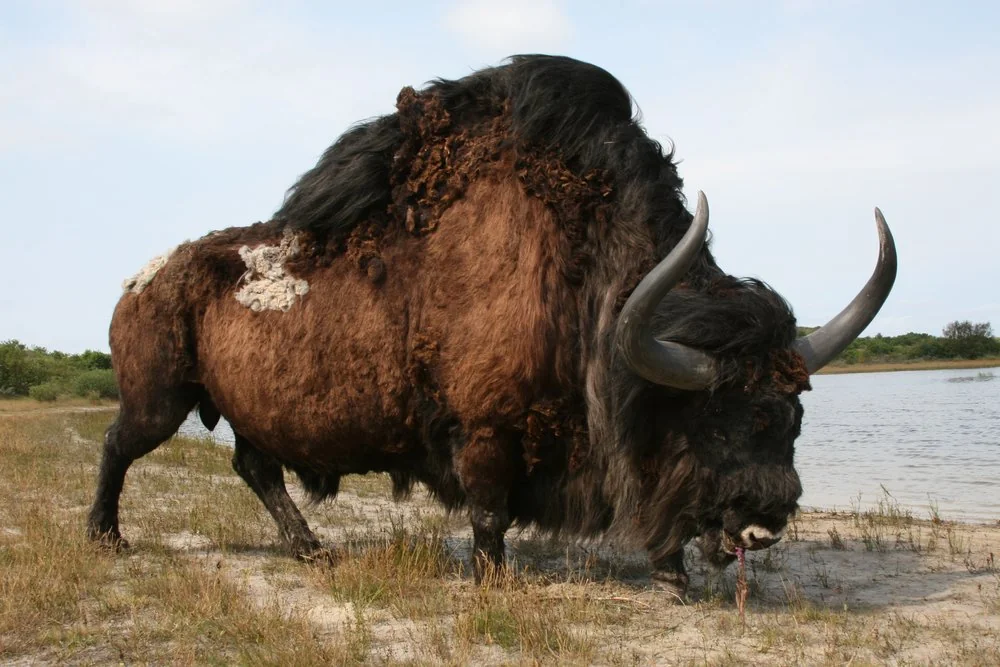
During the Late Pleistocene epoch, an age defined by glacial expansion and migrating megafauna, one creature towered over the grasslands of North America—the magnificent Bison latifrons. Known as the largest bison species ever to walk the continent, it symbolized strength, adaptation, and the astonishing diversity of ancient life.
Stretching up to 4.7 meters in length, standing 2.5 meters at the shoulder, and weighing nearly 2,000 kilograms, this Ice Age herbivore was a true titan. But its most iconic feature was its pair of immense horns, spanning up to 2.1 meters from tip to tip. These massive appendages shaped not only the animal’s appearance but its survival strategies and social interactions across the frozen plains.
The Discovery and Fossil Record of Bison latifrons
The scientific story of Bison latifrons began in the 19th century as North America’s fossil hunters explored ancient sedimentary basins and river deposits. Early remains were unearthed in states like Texas, Kansas, and Nebraska, where river erosion exposed the bones of a long‑extinct giant.
Bison latifrons fossils have since been discovered throughout much of North America—from the Pacific Northwest to the eastern Great Lakes region—indicating a vast geographic range. These findings typically include horn cores, skull fragments, vertebrae, and limb bones, often well‑preserved in ancient floodplains.
Radiocarbon dating places the species between approximately 200,000 and 20,000 years ago, aligning it with the Late Pleistocene’s cold-dry cycles. The distribution of fossils suggests this massive bison thrived in a variety of habitats, from open steppes to mixed woodlands, adapting to shifting climates throughout its existence.
Anatomy of a Giant: Size, Strength, and Adaptations
Enormous Horns and Robust Skull
The horns of Bison latifrons are the largest known among any bovid species. Measuring over two meters across, they required tremendous neck muscles to support their weight. These structures likely served multiple roles:
-
Defensive weapons against predators such as saber‑toothed cats or dire wolves
-
Indicators of dominance and age within the herd
-
Visual signals used during mating displays
The skull of Bison latifrons was thick and heavily buttressed, built to withstand head‑to‑head combat. The shape of the horn cores and the breadth of the frontal bones gave males an unmistakable presence on the Ice Age plains.
Massive Frame and Efficient Limbs
Despite its bulk, Bison latifrons retained an efficient body plan suited to long migrations. Its sturdy legs ended in broad hooves designed to traverse diverse terrain—mud flats, prairies, and icy grasslands. Paleontologists believe its skeletal proportions allowed surprising mobility for such a large animal.

Adaptation for Cold Climates
Isotopic analysis of tooth enamel shows evidence that Bison latifrons grazed on tough, winter grasses. Dense, woolly fur likely insulated it from severe cold, much as modern bison use thick undercoats today. This adaptation helped the species endure glacial conditions that fluctuated between bitter winters and brief warm interglacial periods.
The Paleoecology: Life in the Ice Age Grasslands
During the Late Pleistocene, vast expanses of open grassland spread across North America, providing ideal grazing grounds. These ecosystems, known as “mammoth steppe,” hosted an array of giant herbivores: mammoths, mastodons, giant ground sloths, and camels. Among them, Bison latifrons filled an essential ecological niche.
A Keystone Grazer
As a herbivore that consumed primarily grasses and sedges, Bison latifrons helped maintain biodiversity. Its constant grazing encouraged new plant growth, prevented woody overgrowth, and supported prey‑predator balance within the Ice Age biome. Fossil pollen records indicate that regions heavily populated by large grazers like Bison latifrons saw stabilized vegetation cycles.
Competition and Coexistence
Bison latifrons coexisted with other large grazers such as horse species, pronghorns, and musk oxen. This dynamic led to overlapping feeding territories and seasonal migrations. By moving in massive herds, Bison latifrons likely reduced predation risk while promoting seed dispersal across hundreds of kilometers.
Behavior and Social Structure
Herd Dynamics
Evidence from bone assemblages suggests Bison latifrons lived in structured herds similar to modern bison. Females and young likely formed large groups for protection, while males joined only during mating seasons. Social bonds within herds would have played key roles in defense, migration, and survival.
Communication and Dominance
Vocal calls, body posture, and horn displays likely conveyed social information. Males competed for mates using power displays and controlled horn clashes. Although much larger, their hierarchical social system probably mirrored that of Bison bison (the modern American bison).
Migration Patterns
Seasonal migrations were almost certainly part of Bison latifrons life. Fossil evidence scattered across regions separated by hundreds of miles hints at long‑range movement between summer and winter grazing grounds. Migration helped the species access nutritious forage year‑round and escape harsh winter conditions.
Predators and Threats
Even the largest herbivores faced constant danger in the Ice Age. Bison latifrons’ primary predators included the American lion (Panthera atrox), saber‑toothed cat (Smilodon fatalis), and dire wolf (Aenocyon dirus).
Carnivore tooth marks found on fossil bones suggest active predation and scavenging. While adults were formidable, juveniles and weakened individuals fell prey to these apex predators. The enormous horns and muscular build of Bison latifrons provided defense, but survival also depended on herd protection and group response against attacks.
Evolutionary Lineage
From Ancestral Bison
Bison latifrons evolved from an earlier species that migrated from Eurasia across the Bering Land Bridge roughly 300,000 years ago. This lineage adapted rapidly to North American conditions, developing larger horns and a bulkier body to dominate open plains environments.
Transition to Bison antiquus
As glaciers advanced and climates cooled further near the end of the Pleistocene, selective pressures favored smaller and more energy-efficient forms. Bison latifrons gradually gave rise to Bison antiquus around 20,000 years ago—a transitional species better adapted to variable climates and predation pressures. Bison antiquus later evolved into Bison bison, the modern American bison that still roams the plains today.
This evolutionary sequence illustrates one of the clearest examples of megafaunal adaptation and downsizing in response to environmental change.
Interactions with Early Humans
The overlap between Bison latifrons and early human populations in North America remains an intriguing topic. Although direct evidence of hunting is scarce, stone tools found near certain fossil sites indicate at least opportunistic encounters.
As early Paleo-Indians migrated southward after 25,000 years ago, they would have encountered Bison latifrons herds in open grasslands. Given the difficulty of hunting such a massive animal, early humans may have targeted isolated individuals or scavenged carcasses left by predators.
These early interactions foreshadowed the deep relationship between humans and bison that continued for millennia—culminating in the central role of bison in later Indigenous North American cultures.
Extinction: Climate and Ecological Pressures
Around 20,000 years ago, as the Last Glacial Maximum began to wane, environmental conditions changed abruptly. Shrinking glaciers altered river systems, vegetation zones shifted northward, and grasslands fragmented into patchier habitats.
The enormous size of Bison latifrons, once a strength, became a liability. It required vast foraging areas and large amounts of plant matter each day. With shrinking grazing zones and fewer resources, the species faced high mortality pressures.

Climate Instability
Rapid warming cycles melted ice sheets and flooded plains, disrupting migration routes. Droughts at certain periods likely decimated crucial grasslands. Unable to adapt quickly enough, populations declined.
Replacement by Smaller Descendants
The evolutionary successor, Bison antiquus, thrived in these new conditions due to its smaller size and flexible grazing range. Over thousands of years, Bison latifrons vanished entirely, replaced by its more adaptable descendants before 10,000 years ago.
What Bison latifrons Tells Us About Megafauna Evolution
Studying Bison latifrons provides paleontologists with key insights into Ice Age adaptation, extinction patterns, and ecosystem dynamics.
-
It highlights the impact of body size on survival during environmental upheavals.
-
It demonstrates how horn morphology linked with sexual selection and dominance behavior.
-
It reveals how climate volatility drove evolutionary downsizing and diversification among large mammals.
Moreover, it underscores the deep time continuity of North America’s grazers—from ancient giants to the modern bison still shaping prairie ecosystems today.
Fossil Sites and Notable Discoveries
Major fossil deposits yielding Bison latifrons remains include:
-
Natural Trap Cave, Wyoming: High‑altitude site containing vertebrate remains trapped over millennia.
-
Rancho La Brea Tar Pits, California: Partial horns and skulls preserved in tar suggest coexistence with other Ice Age giants.
-
Cumberland Cave, Maryland: Fossils confirm the species’ eastern range.
-
Old Crow Basin, Yukon: Northernmost finds offering clues about migration corridors during glacial periods.
Each site enriches our understanding of this species’ range and adaptation across varying environments.
Horns as Symbols: From Power to Legacy
The sheer grandeur of Bison latifrons’ horns cannot be overstated. Spanning more than two meters, they remain among the most impressive skeletal structures ever discovered in a mammal.
In Ice Age ecosystems, these horns symbolized dominance. Among modern researchers and enthusiasts, they represent evolutionary creativity and resilience. Reconstructed skulls in museums—massive, curved monuments to Ice Age life—continue to spark wonder and admiration, connecting modern audiences with a world long gone.
Comparisons with Modern Bison
| Feature | Bison latifrons | Bison bison (Modern American Bison) |
|---|---|---|
| Shoulder height | Up to 2.5 m | Up to 1.8 m |
| Weight | Up to 2,000 kg | 900–1,000 kg |
| Horn span | Up to 2.1 m | 60–90 cm |
| Time period | 200,000–20,000 years ago | Present |
| Habitat | Ice Age grasslands, open woodlands | North American plains and prairies |
| Behavioral traits | Herding, seasonal migrations | Similar complex herd structure |
This comparison underscores evolutionary trends toward smaller, more energy-efficient body types as climates changed and resources fluctuated.
Cultural and Educational Significance
Though Bison latifrons vanished long before recorded history, its influence endures through its descendants and educational value. The giant bison provides a tangible link between Ice Age ecosystems and modern conservation science.
Museum Exhibits and Public Engagement
Mounted skeletons of Bison latifrons are centerpiece attractions in several North American museums, including the La Brea Tar Pits Museum and the University of Kansas Natural History Museum. These displays bring the scale of prehistoric life into vivid focus for visitors of all ages.
Inspiration for Paleontology and Ecology
For researchers, Bison latifrons acts as a model species to explore Ice Age transitions, adaptation mechanisms, and extinctions. For the public, it offers a reminder of the fragility and resilience of nature—a theme increasingly vital in modern environmental discourse.
Modern Insights Through Technology
Recent advances in paleogenomics and isotopic analysis are shedding new light on Bison latifrons.
-
Isotopic signatures of teeth and bones reveal details about diet, migration routes, and seasonal variation.
-
CT scanning enables digital reconstructions of skulls without damaging fossils.
-
3D modeling allows accurate estimations of body mass, horn strength, and muscle structure.
-
Comparative DNA studies between fossil and modern bison show clear evolutionary continuity within the genus Bison.
These methods allow scientists to reconstruct not just anatomy but behavior, diet, and environmental interactions in unprecedented detail.

The Ongoing Legacy of the Giant Bison
The extinction of Bison latifrons may have marked the end of an era, but its story continues through the success of its descendants and the researchers dedicated to understanding its world. Its towering horns and colossal frame remain physical metaphors for Ice Age robustness, while its disappearance echoes universal ecological truths: survival depends on adaptability.
As modern conservationists work to restore bison populations, understanding their ancient relatives provides perspective. Bison latifrons teaches that even the most formidable giants can perish when environments shift beyond their limits—a lesson about balance between species and climate that remains relevant today.
Conclusion: The Enduring Symbol of the Ice Age Plains
Bison latifrons stands as one of prehistory’s most impressive mammals—a creature of immense strength, social depth, and ecological influence. Its fossils capture the essence of the Pleistocene world: vast, unpredictable, and teeming with giants.
Within its bones lies a story of adaptation, competition, and ultimate transformation—a legacy that lives on in the modern bison grazing the Great Plains. The tale of this ancient giant continues to fascinate archaeologists, paleontologists, and history enthusiasts alike, reminding us that every species, no matter how great, is connected to the shifting rhythms of Earth’s evolving landscapes.
ALSO READ: Traces of Human DNA Found in Ancient Meteorite: Could Life on Earth Have Interstellar Origins?