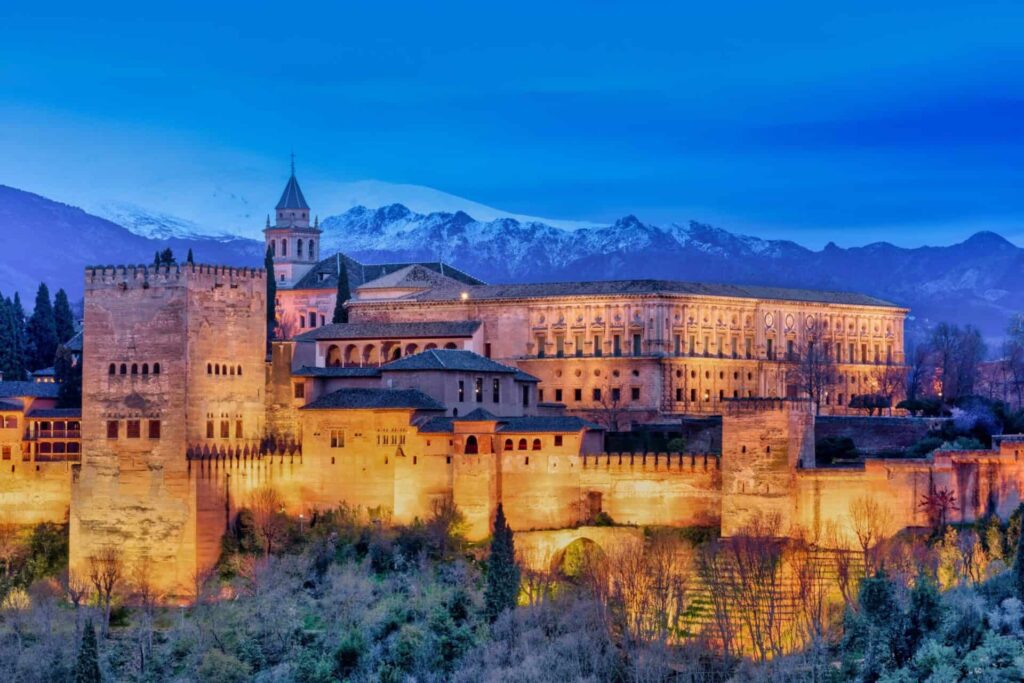
The Alhambra, a sprawling fortress and palace complex rising over Granada, Spain, is more than a testament to medieval military prowess; it is the crowning achievement of the Nasrid dynasty and the single greatest surviving example of Islamic art and architecture in Western Europe. Its existence is inextricably linked to the twilight of Muslim rule on the Iberian Peninsula, a period known as Al-Andalus.
Origins and the Nasrid Establishment
The complex’s history begins officially in 1238 with Muhammad I ibn al-Ahmar, the first Nasrid emir. Amidst the continuous Reconquista by Christian kingdoms, the Nasrids were forced to relocate their capital to Granada, establishing the last Muslim kingdom in Spain. Muhammad I began fortifying the existing hilltop structure, laying the foundation for what would become the Qa’lat al-Hamra, or the “Red Fortress.”
A Cultural Zenith in the 13th and 14th Centuries
The subsequent century saw the Alhambra evolve from a functional fortress into the magnificent palatial city we recognize today. Under rulers like Yusuf I and his son Muhammad V, the focus shifted dramatically from mere defense to the creation of an aesthetic and spiritual haven. This was the cultural zenith of Nasrid rule, where architecture, poetry, and science flourished despite the kingdom’s diminishing political power.
Transition to Christian Rule (1492) and Enduring Legacy
The year 1492 marked a seismic shift when the Catholic Monarchs, Ferdinand II and Isabella I, completed the Reconquista, capturing Granada and ending nearly eight centuries of Islamic rule in Spain. While parts of the complex were later altered, most notably with the construction of the Palace of Charles V, the core Nasrid palaces remained relatively intact. The Alhambra stands today as a profound symbol of Moorish Spain’s final splendor and a crucial document of cross-cultural history.
The Nasrid Dynasty: Architects of a Masterpiece
The Nasrid dynasty emerged from the political fragmentation of medieval Spain. Following the collapse of earlier Islamic empires, the Nasrids, through astute diplomacy and military resilience, managed to establish the Emirate of Granada, holding onto power for two and a half centuries (1238–1492).
The Nasrid Focus on Palatial Architecture
Their architectural philosophy was unique, blending the necessary defense of a walled city with exquisite aesthetic elements that transformed living spaces into sublime expressions of Islamic cosmology. The palaces were designed to offer respite and reflection. Creating a world within walls that evoked the Jannah (paradise) promised in the Quran. The buildings were deliberately conceived not as solid, imposing structures. But as delicate shells of plaster and tile, emphasizing interior beauty over exterior grandiosity. A reflection of the kingdom’s inner artistic wealth contrasted with its external political fragility.
Major Patrons: Yusuf I and Muhammad V
While Muhammad I founded the complex, the most significant expansion and enrichment of the palatial areas occurred under the patronage of Yusuf I (1333–1354) and his son, Muhammad V (1354–1391, with a break).
- Historians credit Yusuf I with much of the Comares Palace and the spectacular façade of the Court of the Myrtles.
- Muhammad V, after regaining his throne, oversaw the creation of the most famous and artistically complex section: the Court of the Lions. His reign represents the absolute pinnacle of Nasrid art.
Islamic Architecture Principles Visible in the Alhambra

The Alhambra is an encyclopaedia of Islamic architectural principles, showcasing a highly developed aesthetic that prioritizes spirituality, harmony, and complex ornamentation over monumental size.
Geometric Precision and Infinity Patterns
A hallmark of Islamic art, the architecture of the Alhambra makes extensive use of geometric precision. This is evident in the complex tiling known as azulejos and the stucco decoration. The patterns employ infinity patterns—interlacing polygons and star shapes that repeat indefinitely. This repetition is not merely decorative. It is a spiritual concept reflecting the belief in the infinite nature of God (Allah) and the underlying order of the universe. The use of tessellations and fractal-like arabesques creates a visual feast where every piece relates mathematically to the whole.
Stucco and Tile Work: Lace and Light
The walls are predominantly covered in two materials:
- Stucco (Plaster): This relatively inexpensive material was meticulously carved while wet into intricate lace-like textures. The depth and complexity of the carvings modulate the natural light. Making the walls appear to shimmer and change throughout the day.
- Tile Work (Azulejos): Used primarily in the lower sections of walls to protect the surface from humidity, these brightly colored, glazed tiles form stunning geometric compositions that ground the more ethereal plaster work above.
Calligraphy: Spiritual and Decorative Art
Calligraphy in the Alhambra is seamlessly integrated into the decoration, serving both a spiritual and aesthetic function. Inscriptions include:
- Quranic Verses: Lending divine authority and blessing to the spaces.
- Poetry: Verses celebrating the beauty of the palace, the prowess of the Sultan, or the symbolism of water and paradise.
- The Nasrid Motto:Artisans inscribed the phrase wa la ghaliba illa Allah (“There is no conqueror but God”) countless times throughout the complex, creating an underlying, rhythmic pattern.
The Marvel of Muqarnas
Perhaps the most distinctive element is the muqarnas (or mocárabe in Spanish). This is a form of stalactite-like vaulting used to transition between architectural elements, such as the dome and the wall, or to decorate ceilings and arches. Constructed from small, three-dimensional elements, the muqarnas appears to defy gravity, adding a breathtaking sense of complexity and weightlessness to the ceiling of rooms like the Hall of the Abencerrajes and the Two Sisters.
Structural Organization: Interiority and Contemplation
Unlike European architecture which often celebrated the exterior facade, Nasrid design emphasized interior courtyards and reflecting pools. The most public face of the palace was the least decorated. The most dazzling art was reserved for the interior spaces, accessible only to the court, reinforcing the private. Contemplative nature of the palace and symbolizing the hidden perfection of the divine.
The Court of the Lions: Symbolism and the Paradise Garden
The Patio de los Leones (Court of the Lions), built during the reign of Muhammad V, is the centerpiece of the Nasrid Palaces and the most powerful example of the Alhambra’s symbolism. It represents the architects’ vision of an earthly representation of the divine garden or paradise (Jannah).
Design and Symmetry
The courtyard is designed with a perfect symmetry, a classic quadripartite (four-part) layout inspired by Persian garden tradition and Islamic cosmology. Four water channels flow outwards from the central fountain. Dividing the space into four quadrants, often interpreted as the Four Rivers of Paradise mentioned in the Quran (of water, milk, wine, and honey).
The Twelve Marble Lions
The central focal point is the famous fountain, supported by twelve stylized marble lions. The interpretation of these figures is complex and debated:
- Symbolism: They may represent the Twelve Tribes of Israel (a reference to King Solomon’s legendary throne) or the twelve signs of the Zodiac. Their function, however, is purely structural and symbolic, not religious, as representational animal sculpture was rare in Islamic art.
- Hydraulic Engineering: An elegant arcade of 124 slender white marble columns surrounds the courtyard.
Arcade and Arches
An elegant arcade of 124 slender white marble columns surrounds the courtyard. These columns are deliberately delicate, creating a sense of lightness and openness. They support the intricate mocárabe arches above, further blurring the line between solid architecture and delicate, suspended decoration.
Light and Water: The Dynamic Elements of the Alhambra

The success of the Alhambra’s design lies in its mastery of two dynamic, fleeting elements: light and water. These elements transform the static architecture into a sensory, spiritual experience.
The Role of Natural Light
Artisans specifically engineered the depth and texture of the stucco decoration to interact with the sun. As the day progresses, the changing angle of the light causes the intricate patterns to modulate. Shadows lengthen, textures deepen, and the walls seem to move and breathe. This constant visual transformation emphasizes the fleeting nature of the material world and the permanence of the divine order. Represented by the underlying mathematical patterns.
Water as a Cooling and Spiritual Element
Water is the soul of the Alhambra. It is present in three primary forms, each serving both a functional and a spiritual purpose:
- Reflecting Pools: Pools like the one in the Court of the Myrtles create perfect, shimmering reflections of the architecture, doubling the perceived space and height, and adding a dimension of stillness and contemplation.
- Flowing Channels: Small, narrow channels (like those in the Court of the Lions) carry water through the complex, symbolizing the eternal flow of life and the rivers of Paradise.
- Fountains: The sound of running water provides a constant, soothing white noise, effectively masking the sounds of the court and external city, enhancing the contemplative atmosphere.
Advanced Hydraulic Engineering
The ability to sustain this water-rich environment atop a dry hill was a triumph of advanced hydraulic engineering. Engineers primarily designed the system as gravity-fed, drawing water from the Darro River through the Acequia Real (Royal Canal)—a sophisticated network of channels, cisterns, and distribution points that maintained consistent water pressure for the fountains and supported functional needs, including the integrated thermal baths.
The Mathematical and Artistic Harmony

The Alhambra is a physical manifestation of the Islamic belief that mathematics is the language of God. The beauty of the palace is not accidental; it is a calculated, harmonious fusion of art and advanced mathematical concepts.
Geometry, Proportion, and Fractals
The design is built upon rigorous application of geometry and proportion. Scholars have demonstrated that the decorative patterns and even the palace layouts employ sophisticated mathematical principles:
- Symmetry Groups: The Nasrid tile artisans achieved all 17 possible wallpaper groups (plane symmetry groups) in their geometric patterns, a feat only scientifically proven centuries later. This reflects an intuitive, empirical understanding of high-level mathematics.
- Proportion: The use of the Golden Ratio and simple root proportions guides the spatial design and the relationship between architectural elements, ensuring aesthetic balance.
This calculated beauty served as more than ornamentation; it was a form of prayer and meditation. By contemplating the infinitely repeating, non-representational patterns. The visitor was meant to grasp the unity (Tawhid) and infinite perfection of the divine.
The Alhambra’s Spiritual and Cultural Impact
The Alhambra was not just a seat of political power. It was a vibrant, multi-layered cultural hub—a city of both rulers and the intellectual elite.
A Sanctuary for Intellect and Mysticism

The courts of the Nasrid sultans were patrons of poets, philosophers, and Sufi mystics. The architecture itself reflects this spiritual depth:
- Cosmology: The design reflects Islamic cosmology and divine order. The transition from the simple, grounded forms of the lower walls to the ethereal, complex forms of the ceilings (like the muqarnas) symbolizes the journey from the material world to the heavens.
- Symbolism: The careful control of light, the presence of water, and the pervasive inscriptions acted as constant reminders of the divine, transforming secular spaces into deeply spiritual ones.
Enduring Influence and Modern Significance
The Alhambra’s unique aesthetic has had a lasting influence on later Spanish and European architectural styles, notably the Mudejar style (blending Islamic and Christian traditions) and, centuries later, inspiring Romantic and Orientalist movements. Today, UNESCO recognizes and celebrates the Alhambra as a World Heritage site and a symbol of cross-cultural history, dialogue, and the transcendent power of art and mathematics.
Visitor Experience and Preservation: A Journey Through Time
Visiting the Alhambra is intended to be a journey through time and space. An experience where the careful choreography of movement, light, water, and stone envelops the visitor.
The Sensory Journey
The experience moves from the sturdy, military Alcazaba fortress to the serene. Delicate Palacios Nazaríes (Nasrid Palaces) and the restful Generalife gardens. The sensory design compels the visitor to slow down: to listen to the whisper of water. To observe the reflections in the pools, and to contemplate the ever-changing light on the plaster.
Contemporary Preservation
Maintaining the complex is a continuous, delicate task. Contemporary restoration efforts must balance the preservation of the fragile, centuries-old materials (especially the stucco and tile work) with the demands of public access. Conservation scientists employ modern methods to stabilize structures while respecting the traditional materials and techniques used by the Nasrid artisans.
A Muse for the Arts
The Alhambra’s mystical atmosphere and rich history have long made it a muse.
Consequently, Washington Irving’s Tales of the Alhambra famously brought the complex to international attention in the 19th century, romanticizing it and helping to ensure its protection during a period of neglect.
Today, the complex continues to inspire artists, historians, and tourists. Celebrating its transcendent beauty and its profound contribution to human culture.